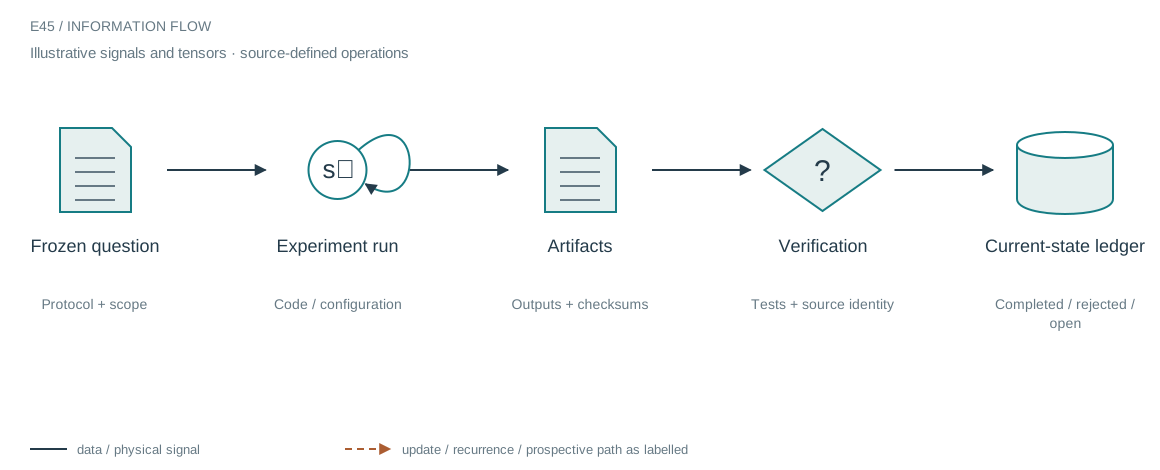
The architecture in context
The system we are building
A long research archive accumulates instructions that were valid at different times. The selected project-state file opens with a current summary and links to dated reports, then explicitly marks older material as historical. That structure matters when a person or agent resumes work months later: old present-tense prose is not a new authorization to restart a closed search.
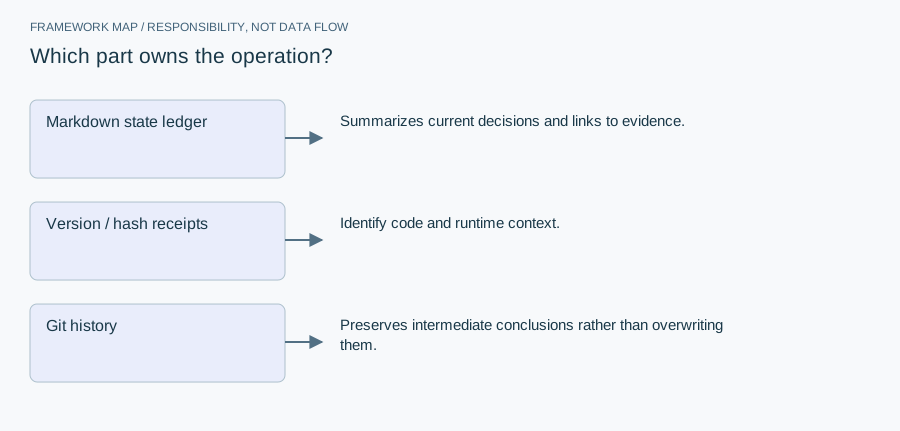
Who does what in the stack
- Markdown state ledger
- Summarizes current decisions and links to evidence.
- Version / hash receipts
- Identify code and runtime context.
- Git history
- Preserves intermediate conclusions rather than overwriting them.
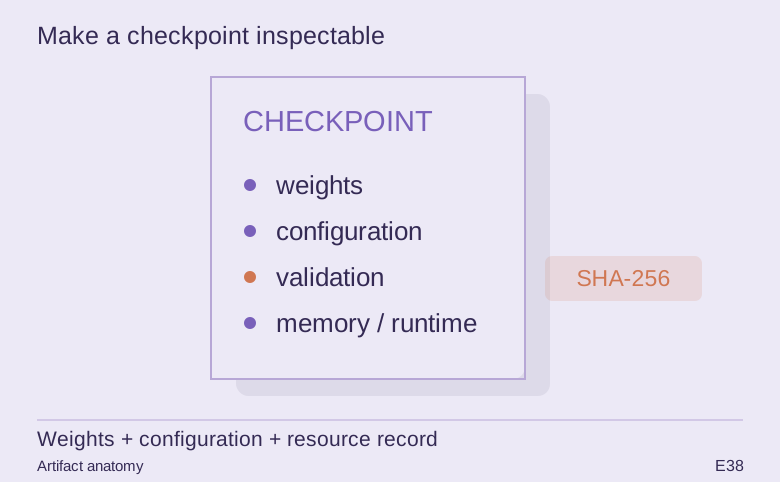
The project adds closure decisions, resource boundaries and source-linked findings to its status record. The companion excerpt comes from a run’s dependency-receipt function, illustrating the lower-level evidence that a useful ledger points to. A Markdown summary is not itself a trained model.
Open up the implementation
A project ledger is not a benchmark table
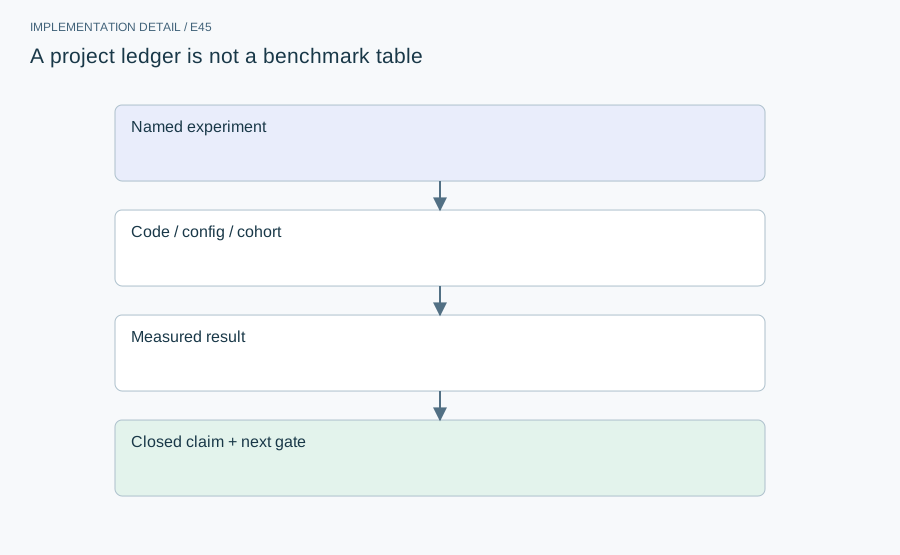
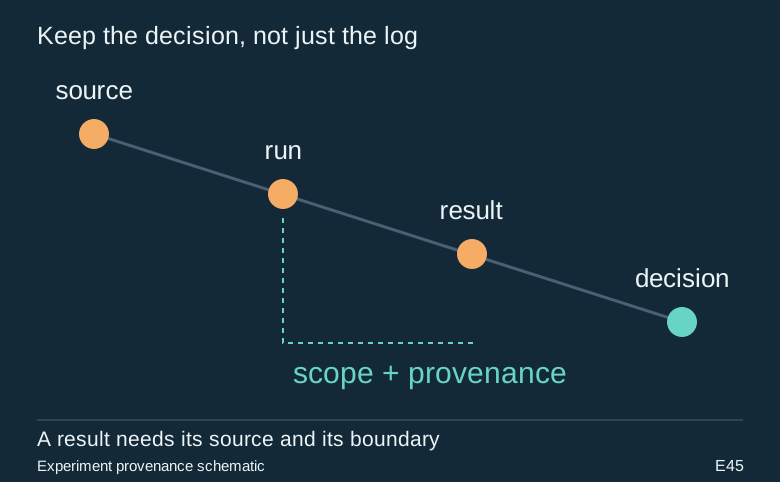
The ledger connects research claims to actual experiments and preserves negative outcomes. Its role is to prevent a later implementation improvement from retroactively changing what an earlier run established. A closed experiment should retain its target and acceptance criteria even when a new experiment follows.
The mathematical contract
A concise status record is useful only if readers can recover the artifact and its context. Numbers copied without units, seed count or benchmark identity become harder to audit than the original logs. A model card should link to evidence, not treat a progress narrative as measurement.
Implementation and resource card
- Capacity / budget
- Status evidence; no independent network, training run or parameter count.
- Execution evidence
- This revision inspects and explains the archived implementation. It does not rerun the original workload. No unrecorded convergence time, throughput or accelerator result is supplied.
- Current reproduction context
- Current workstation, supplied by the author: Apple M4, 128 GB unified RAM, 40 GPU cores and 16 CPU cores. This is context for prospective reproduction, not attribution of every archived run. Python and framework versions are not fully locked for these historical sources; declarations, when available, are identified separately.
From explanation to a reproducible check
Pick one result and follow it to source, configuration, output and conclusion. Require an explicit distinction between a test that passed, a hypothesis that remains open and a gate that failed.
Preserve input identities, configuration and failure records with the result. A successful numerical check only establishes the operation it exercises: it does not certify an entire dataset, model or deployed system. Reproduce the interface on a small deterministic input before optimizing throughput or increasing workload size.
A closer look at the implementation
The code that carries the idea
Dependency versions, source identity, configuration and numerical outputs serve different purposes. The receipt records a reproducibility context; the ledger explains which result governs the current interpretation. Neither should be replaced by a manually curated list of successes.
def dependencies():
    result=source.dependencies()
    for name in ('apps_industrial_breakthrough/locomotion_policy_learning333.py',
                 'apps_industrial_breakthrough/locomotion_policy_learning_gate333.py'):
        result[name]=hashlib.sha256((p.ROOT/name).read_bytes()).hexdigest()
    package=Path(stable_baselines3.__file__).parent
    for name in ('sac/sac.py','sac/policies.py','common/off_policy_algorithm.py','common/buffers.py','common/distributions.py'):
        result[f'stable_baselines3/{name}']=hashlib.sha256((package/name).read_bytes()).hexdigest()
    result['stable_baselines3_version']=stable_baselines3.__version__; result['torch_version']=torch.__version__
    if stable_baselines3.__version__!='2.9.0': raise RuntimeError('Pinned SAC version required')
    return result
Verbatim archive excerpt from locomotion_policy_learning_gate333.py (companion source E38). Context-dependent historical code, not a standalone runnable program. Comments retain their original wording; the article distinguishes implemented behavior from stale or overbroad comments.
The boundary that matters
The current state preserves failed capability gates alongside useful engineering components. It does not imply that all historical claims were revalidated. A status page can become misleading if an old headline survives after its supporting claim was corrected.