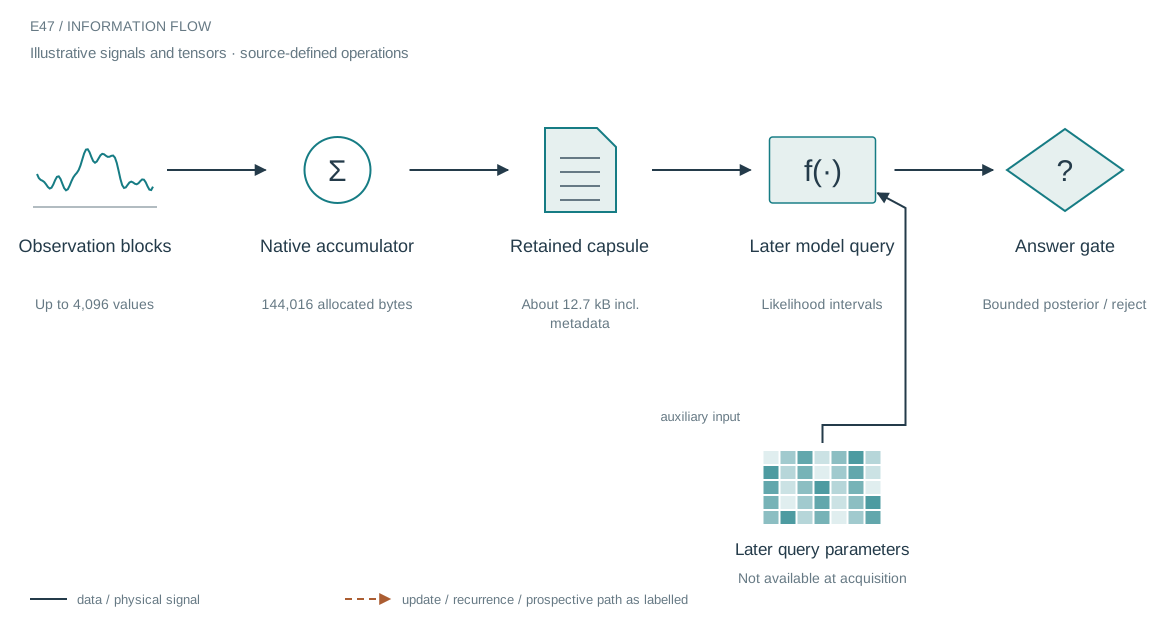
The architecture in context
What this comparison asks
The physical-memory study retains selected statistics for a declared family of later queries instead of preserving arbitrary raw history. Its final streaming panel separates acquisition memory, retained bytes, process memory and answer accuracy. This is a practical compression pattern: specify what future questions the representation must still support.
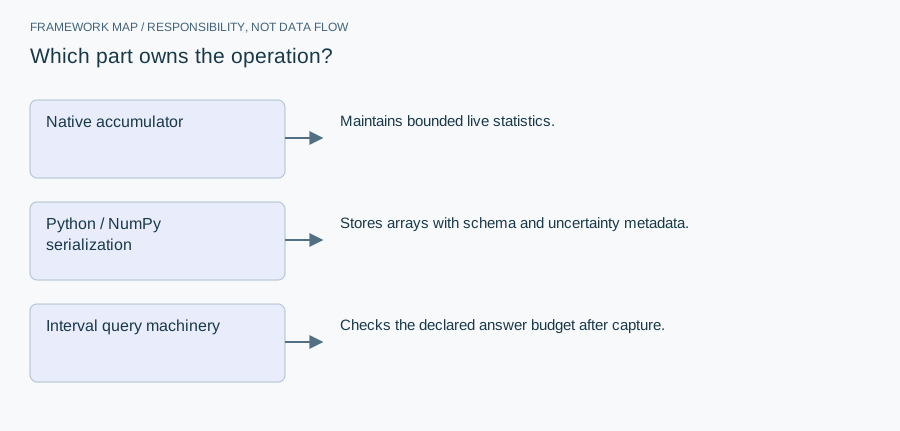
Who does what in the stack
- Native accumulator
- Maintains bounded live statistics.
- Python / NumPy serialization
- Stores arrays with schema and uncertainty metadata.
- Interval query machinery
- Checks the declared answer budget after capture.
The project combines a native accumulator with Python query and verification machinery. The excerpt comes from the companion capsule serializer, where numeric payload, schema metadata, uncertainty radii and an integrity hash travel together. A retained capsule is a query snapshot, not a restart image of the full live accumulator.
Open up the implementation
Budget retained state and query cost separately
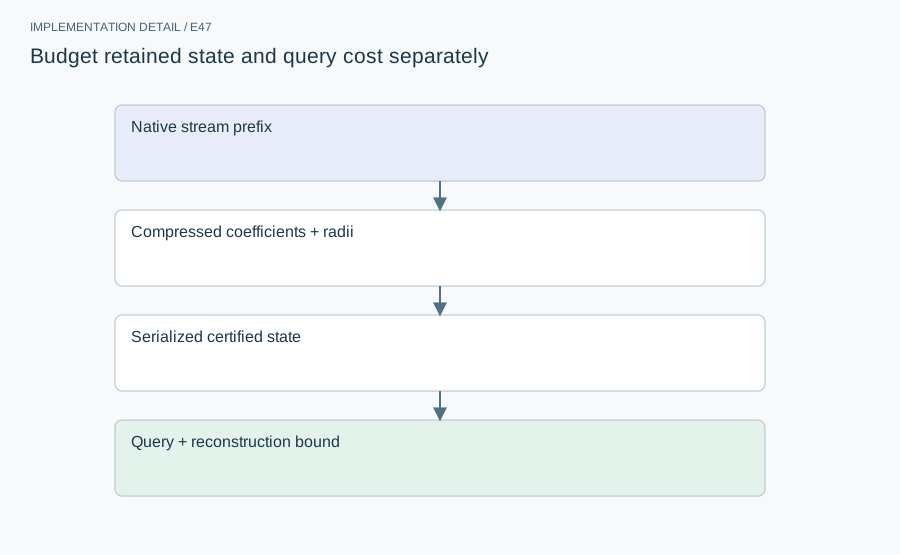
The compact state preserves a specified family of queries with an associated error bound. It does not retain arbitrary historical access. Serialization includes metadata, radii and integrity information; those bytes belong in the comparison. A query that needs preparation can cost much more than its final dot product.
The mathematical contract
Tighter tolerance can increase retained state or reject a stream. The saved panel has failed as well as passed cases. Repeated prefixes from the same streams are correlated evidence, not independent datasets. Compact representation and fast end-to-end service are two separately measured objectives.
Implementation and resource card
- Capacity / budget
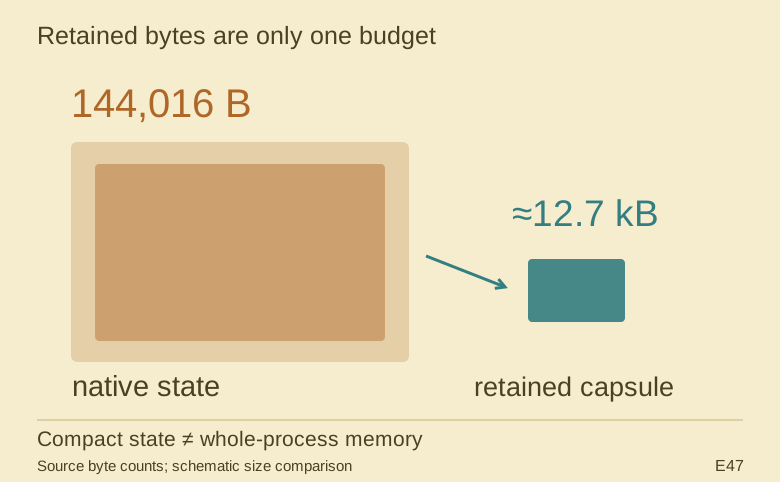
- Selected artifacts:144,016 native bytes versus about 12,700 retained bytes. Peak process RSS is over 100 MiB; retained bytes are not whole-process memory.
- Execution evidence
- This revision inspects and explains the archived implementation. It does not rerun the original workload. No unrecorded convergence time, throughput or accelerator result is supplied.
- Current reproduction context
- Current workstation, supplied by the author: Apple M4, 128 GB unified RAM, 40 GPU cores and 16 CPU cores. This is context for prospective reproduction, not attribution of every archived run. Python and framework versions are not fully locked for these historical sources; declarations, when available, are identified separately.
From explanation to a reproducible check
Round-trip the serialized state and verify query bounds against a reference for the declared query family. Report capture, preparation and steady query time separately, alongside retained bytes and peak RSS.
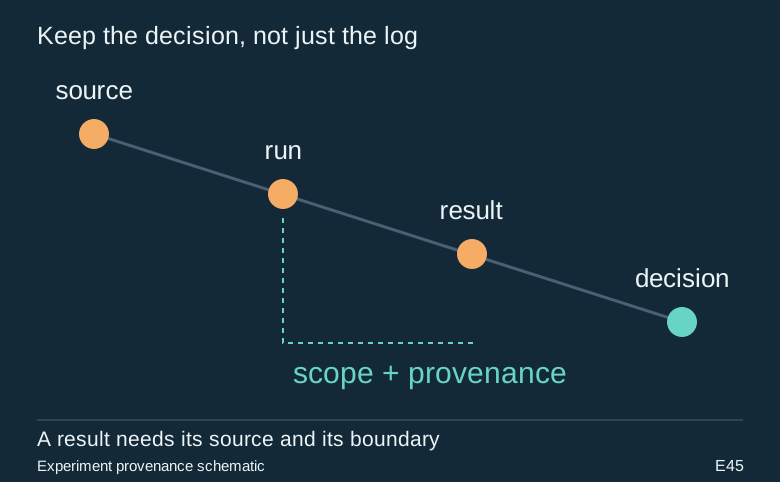
Preserve input identities, configuration and failure records with the result. A successful numerical check only establishes the operation it exercises: it does not certify an entire dataset, model or deployed system. Reproduce the interface on a small deterministic input before optimizing throughput or increasing workload size.
A closer look at the implementation
The code that carries the idea
The final report records capsules of 12,700–12,703 bytes and fixed native allocation of 144,016 bytes. All eight million-sample cases pass the declared posterior bound; only two of eight four-million-sample cases do. The complete scale-up gate therefore fails despite small measured discrepancies against the floating reference.
        E+=self.n*point(offset)**2
        return outward(E)[1]
    def dumps(self):
        payload=np.r_[self.acf,self.head,self.tail].astype('<f8').tobytes()
        meta={'schema':'pairwise_enclosed_lag_v1','n':self.n,'lag':self.lag,'dt':self.step,
            'total':self.total,'energy_upper':self.energy_upper,'acf_radius':self.acf_radius,
            'total_radius':self.total_radius,'dtype':'<f8','noise_variance':.04,
            'input_nonzero_range':[2.**-200,2.**200],'arithmetic':'binary64_nearest_pairwise_no_reassociation'}
        header=json.dumps(meta,sort_keys=True,separators=(',',':')).encode()
Verbatim archive excerpt from certified_capture.py (companion source X02). Context-dependent historical code, not a standalone runnable program. Comments retain their original wording; the article distinguishes implemented behavior from stale or overbroad comments.
The boundary that matters
Allocated native bytes are not whole-process RSS or an embedded-device measurement. The final paired prefixes represent four underlying streams, not sixteen independent physical recordings. The checksum protects integrity, not the numerical truth of the enclosed answer.