The hidden danger in a smaller model
A predictor may look excellent when each step receives the true previous output and fail when it must consume its own predictions. That happened in the aircraft study: a pruned cardinal surrogate had low teacher-forced error but free-run error of 1.73593. Keeping most of a weight matrix’s energy also failed. The missing property was not merely static approximation accuracy.
Where the dynamics survive compression
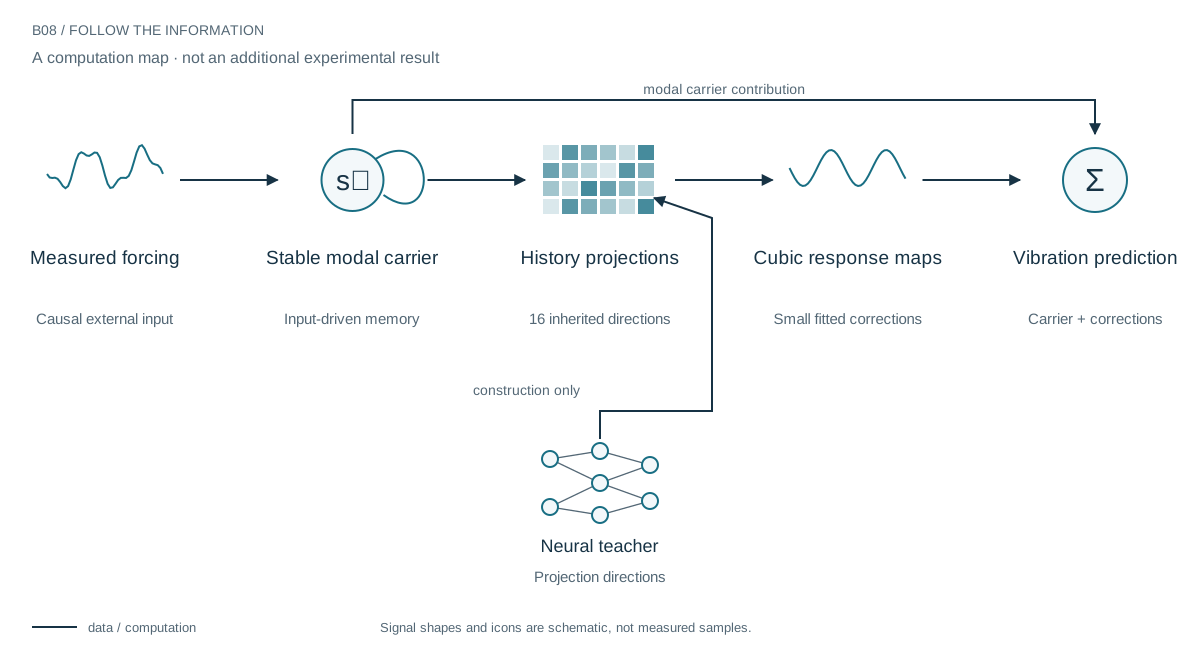
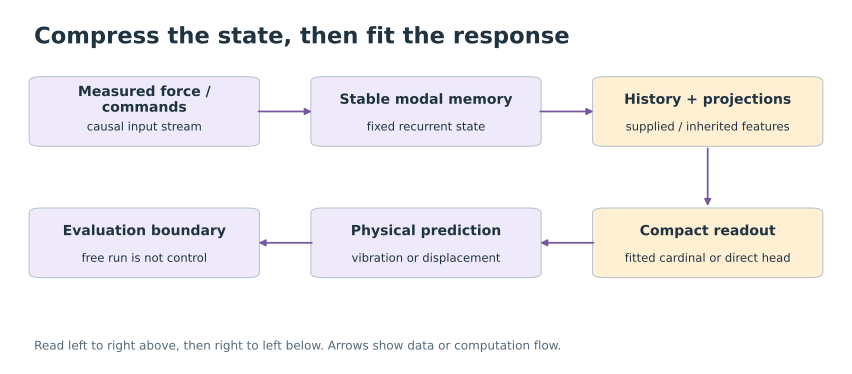
The aircraft compiler begins with measured forcing, not its own predicted vibration. Stable modes carry the history forward; finite input and carrier histories then pass through inherited projection directions and small fitted cubic response maps. The prediction combines the modal carrier with those corrections. This removes a predicted-output feedback path that can amplify small approximation errors.
The local teacher uses a different initialization: it begins autoregressive evaluation with measured output history. The compiler does not. Reporting that difference is part of understanding the architecture, not a footnote to the parameter count. Likewise, learning the modal carrier and selecting teacher directions are acquisition work even when the resulting deployed arrays are small.
Compile the state instead
The successful construction replaces measured or predicted output history with a causal modal carrier driven only by the input force. Sixteen directions inherited from a neural teacher then feed small cardinal response functions. The carrier’s poles remain inside the unit disk, so bounded force produces bounded modal state. There is no predicted-output feedback to amplify a readout mistake.
A measured aircraft result
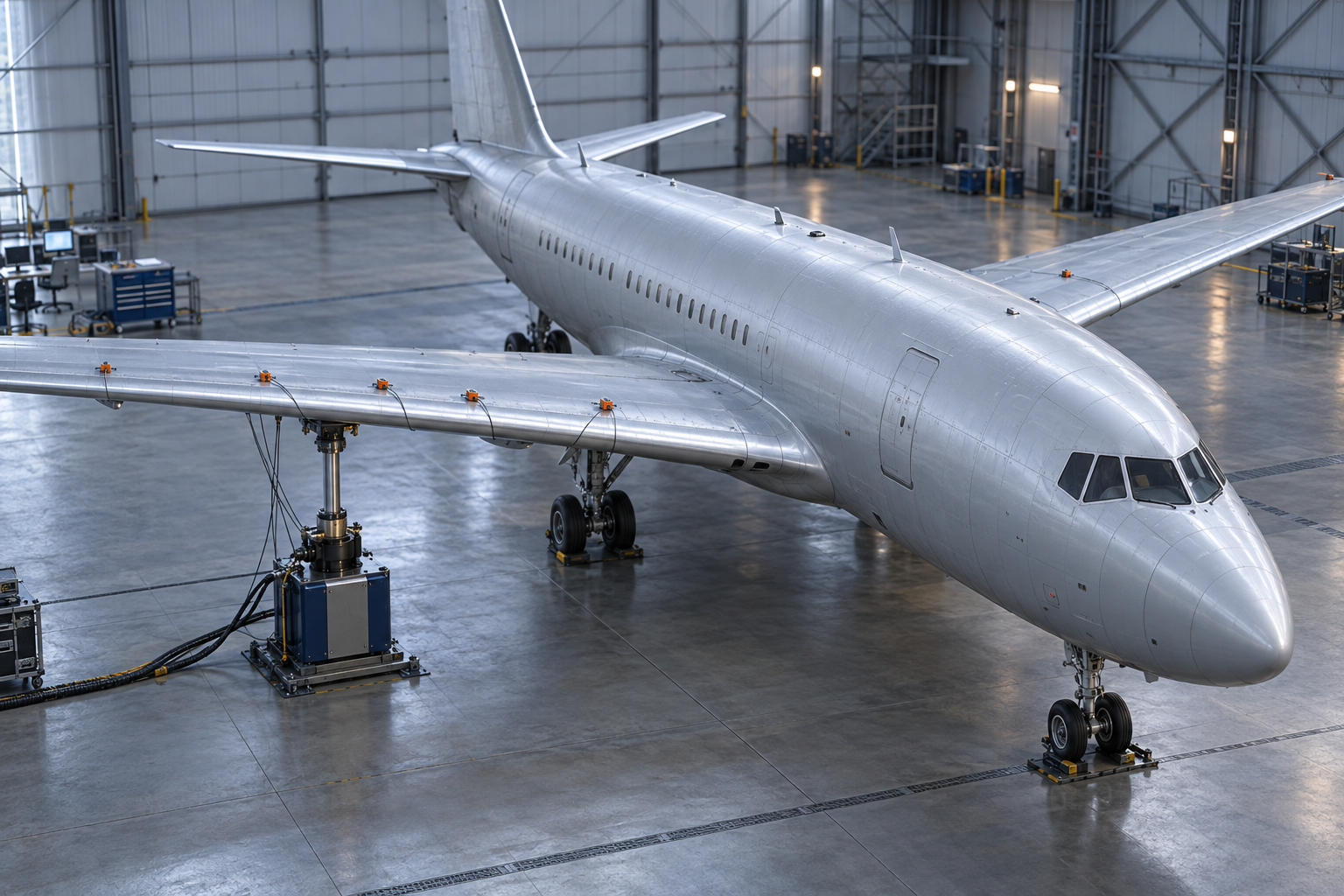
On the official F-16 vibration record, the compiled model reaches mean channel RMSE 0.49899. The same local neural teacher reaches 0.48940: the compact model is close, not more accurate. Its counted deployment arrays occupy 38,248 bytes versus 266,252, a 6.96-fold reduction. Unlike the teacher’s autoregressive evaluation, it does not use the first 64 measured outputs to initialize predictions.
Count what was inherited
The directions came from a trained teacher; the stable modal dictionary and source fitting are also supplied. This is not identification without prior knowledge or learning an aircraft from a few coefficients. The archived split, ridge choices, output initialization, and resource definitions are explicit in the paper. The official-record result is one measured system, not a universal statement about neural dynamics.
A compact model that remembers the forcing
The intended application is a compact executable vibration model for monitoring or simulation. The result is close to a locally reproduced teacher, not a model of aircraft flight or an airworthiness claim. Its most general lesson is to preserve the right causal state before pruning nonlinear computation.
Why this is more interesting than pruning alone
The compiler changes the operational source of memory. It retains causal state and learns a small nonlinear correction rather than hoping that a weight approximation preserves feedback behavior. That is a reusable design idea for compact learned physical models. Bounded output still does not certify passivity, controller stability, or safe aircraft operation.
Evidence & further reading
The links below distinguish the project record from foundational literature. This revised story does not add a new application-validation experiment.
- Consolidated research results, including constitutive edges and continual memory. Daniel Schmitter (2026). Local archive snapshot.
- Experiment-family evidence map. Spline research archive (2026). Local archive snapshot.
- Consolidated limitations and research boundaries. Daniel Schmitter (2026). Local archive snapshot.