Keep a problem, not only its first answer
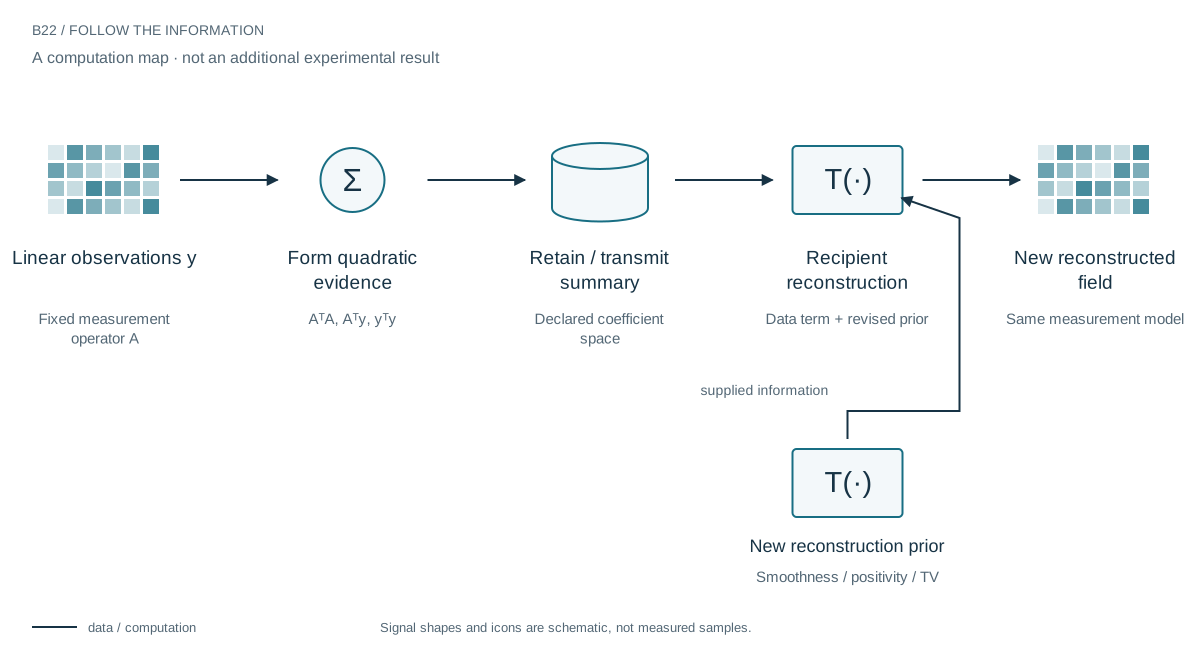
A scan may initially be reconstructed with a smoothness prior and later need an edge-preserving prior. If a fixed linear measurement model and squared loss remain appropriate, its normal matrix and right-hand side retain the data-dependent part of both problems. The recipient can change the prior without receiving the original measurements again.
A recipient can change the prior, not the past
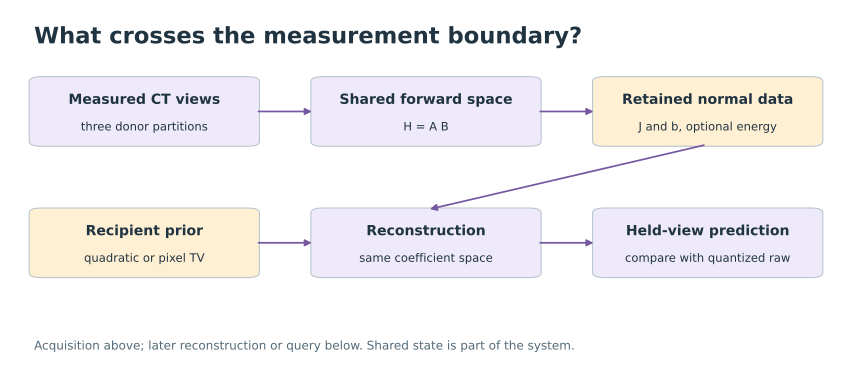
The donor sends the quadratic data term in a fixed measurement space. The recipient can later prefer smoothness, impose positivity, or use a different prior without receiving the raw observations again. The measurement model and its coefficient space remain shared. Absolute likelihood-like values additionally need the discarded constant term.
Now imagine adding a feature outside that measurement span. Two original records can agree on every transmitted statistic and disagree on the correlation with that new feature. No decoder can tell them apart. Exact spline refinement preserves an old reconstructed function; it does not restore the unmeasured directions of its fitting evidence.
The identity is simple and powerful
Expanding the squared residual produces a quadratic form, a linear term, and a constant. The first two determine the minimizer for any later prior in that same coefficient space. The constant is needed for absolute objective values. This is classical least-squares sufficiency, not a new privacy guarantee or arbitrary compression of a sensor history.
A model can carry the same information
If the recipient knows the donor’s normal matrix and regularizer, an invertible regularized fit can be multiplied back to recover its right-hand side. Fitted coefficients and explicit statistics can therefore be information-equivalent messages. Comparing pooled statistics only with a naive average of predictions would create an artificially weak baseline.
New coordinates can require new evidence
Suppose a new feature has a component outside the old measurement span. Two observation vectors can agree on every old statistic and differ on the new one. No deterministic decoder can know which new value is correct. Refining a spline can preserve the old function perfectly while still lacking historical information for the new degrees of freedom.
A memory of answerable future questions
This is a precise form of reusable scientific memory. It is valuable when future questions are known well enough to define the retained space. The walnut experiment also shows why that capability should not be confused with a unique spline codec: matched model messages and ordinary cosine spaces can retain the same kind of information.
The experiment confirms the boundary, not a compression win
The walnut study reproduces fixed-space reconstructions closely from retained statistics, including a nonlinear TV prior. But its spline messages lose to matched cosines and quantized raw controls. The enduring result is an explicit interface: what can be revised, which matrices are shared, and which future changes need additional measurements or richer retained information.
Evidence & further reading
The links below distinguish the project record from foundational literature. This revised story does not add a new application-validation experiment.
- Measured inspection-memory admission and information boundaries. Daniel Schmitter (2026). Local archive snapshot.
- PASS-GLM: polynomial approximate sufficient statistics for scalable Bayesian GLM inference. Jonathan H. Huggins, Ryan P. Adams and Tamara Broderick (2017). Primary literature.
- An Inner-Product Calculus for Periodic Functions and Curves. Anaïs Badoual, Daniel Schmitter and Michael Unser (2016). Primary literature.