Start from measured projections
The experiment uses a public walnut CT slice and its supplied fan-beam matrix, not targets generated by the same spline basis we later fit. Three simulated donors each receive thirty views. Fifteen additional views select regularization, and fifteen remain unscored. The task is prediction of held measured views on one specimen—not diagnosis or ground-truth image reconstruction.
Follow the bytes, not only the image
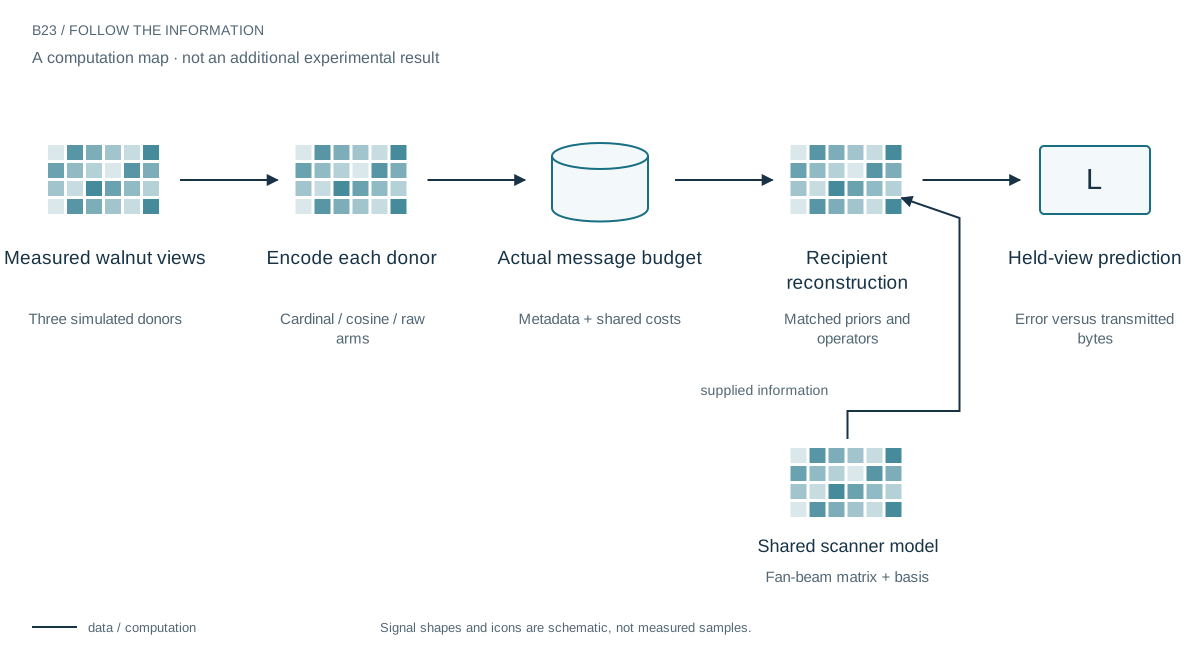
Each simulated donor receives thirty measured projection views. Its compact message is decoded with a shared scanner matrix and represented image basis. The recipient then chooses a reconstruction prior and predicts held measured views. The attractive image is an output of this whole pipeline, not a ground-truth label against which the method was trained.
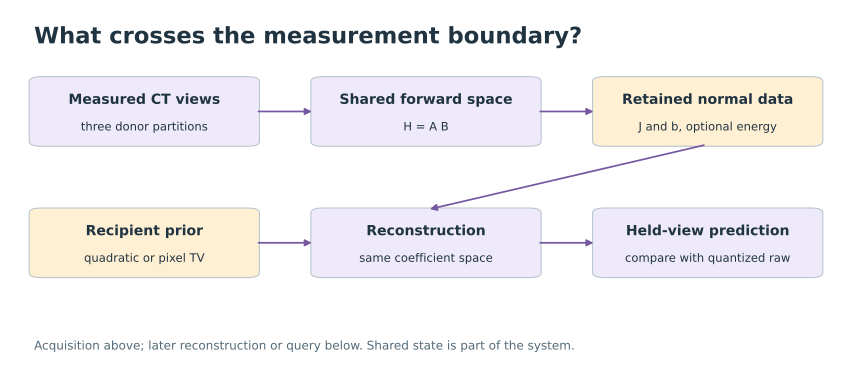
A fair resource comparison includes the shared operator separately from per-scan transmission. The tiny messages rely on megabytes of retained operators and normals. Raw eight-bit measurements use a different tradeoff: more direct observation access and an ordinary TV reconstruction. That control is both smaller and more accurate than the two larger cardinal messages.
Give the simpler alternatives a fair chance
Cardinal and cosine spaces have exactly the same dimensions and numeric message budgets. Raw observations are also quantized to eight or sixteen bits and reconstructed with ordinary nonnegative total variation. Shared measurement operators, cached normals, metadata, and file overhead are accounted for separately. A small transmitted vector does not mean the whole system has that memory footprint.
The frontier rejects the proposal
At 1,156 coefficients, cardinal error is 0.063146 and cosine error is 0.055151, with the same 14,100-byte messages. Eight-bit raw plus TV reaches 0.042262 using 7,608 bytes. Cosine wins at every matched dimension. The raw control is both smaller and more accurate than the two larger cardinal messages. That is the result, not an inconvenient baseline to omit.

A different prior did not rescue it
A separately frozen diagnostic gives both compact spaces the same TV prior. The ranking remains unfavorable to cardinal within the stated budget. All six tighter compact solves miss their strict feasibility tolerance, so they are not certified optima. The paper reports this qualification and the complete trial accounting rather than implying that every possible spline reconstruction has been ruled out.
What would make compressed inspection useful?
The broader goal remains valuable: let an inspection system answer a useful new question without shipping every measurement. This experiment says that the tested cardinal message is not yet the right route. Showing the real reconstructions and complete error–byte frontier is the most informative way to communicate that result.
What a better inspection claim would need
The ambitious application is to answer a valuable new inspection question using fewer additional measurements. That requires actual defect or geometry ground truth, multiple specimens, and a strong targeted-acquisition comparator. Fixed-space algebra remains useful infrastructure, but it did not establish that capability here. The reserved views remain closed and the bounded study is finished.
Evidence & further reading
The links below distinguish the project record from foundational literature. This revised story does not add a new application-validation experiment.
- Measured inspection-memory admission and information boundaries. Daniel Schmitter (2026). Local archive snapshot.
- Experiment-family evidence map. Spline research archive (2026). Local archive snapshot.