Two numbers answer different questions
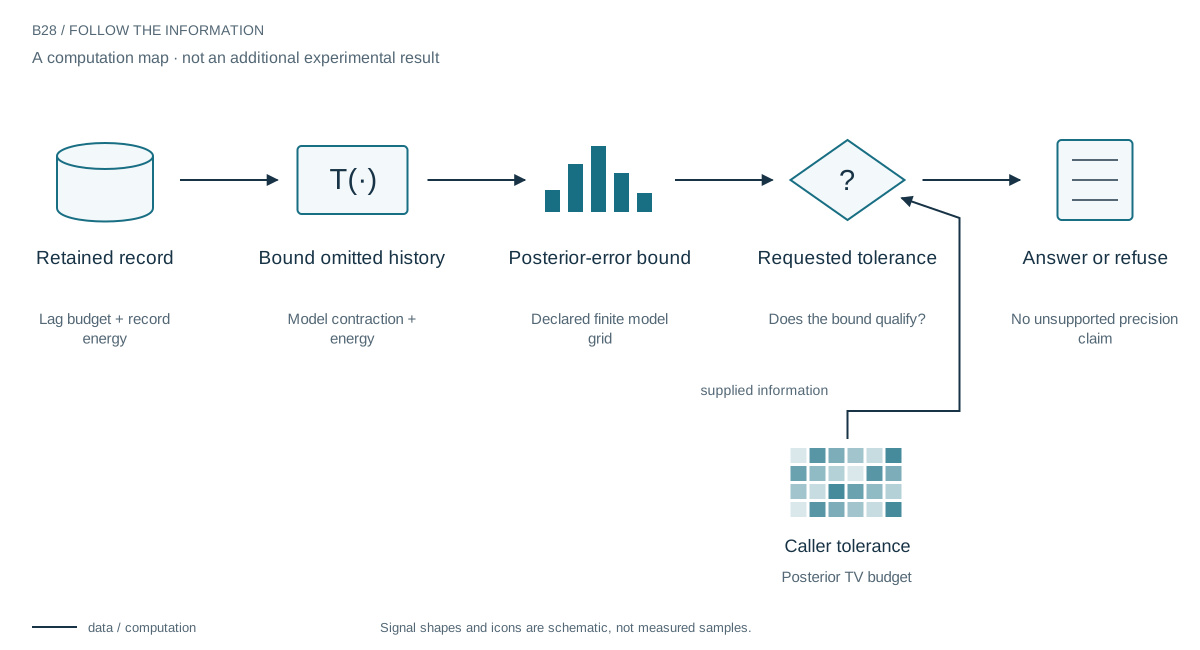
The observed discrepancy tells us how far a compressed calculation was from a reference on a particular test. A computable bound tells the future recipient how far it could be without consulting discarded data. Those numbers can be very different. If the application needs the latter promise, a small observed discrepancy cannot substitute for it.
The summary has a refusal condition
A fixed retained lag can work well for one duration and fail its guarantee for a longer one. Even if per-observation dependence decays, total log-likelihood accumulates evidence. The record-specific bound also depends on retained energy. Small observed posterior error in a reference run is not permission to ignore a bound that exceeds the declared tolerance.
The scale-up retains the same model grid, lag, priors, and error target. All million-sample cases pass. Six of eight four-million-sample cases fail the assurance budget while still showing small observed discrepancies. These are related prefixes, not independent long-duration discoveries.
Long histories are a harder inference problem
An average loss can remain stable while total log-likelihood error grows with the record. Posterior probabilities depend on relative likelihoods across hypotheses. That is why the tiny mean-loss summary in our companion study does not automatically become an unlimited-duration Bayesian memory. Its objective and its error criterion are different.
Use the retained energy to bound this record
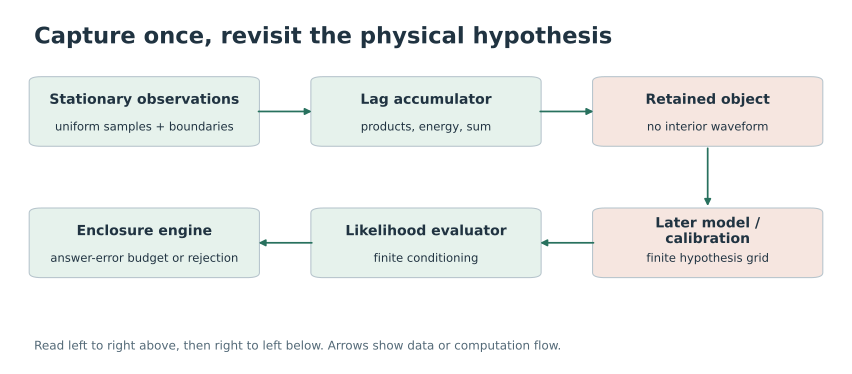
The physical-memory analysis first bounds how much a stable predictor forgets beyond its retained lag. A Gaussian matrix argument then combines that model bound with the actual energy stored in the record. The resulting likelihood-error intervals bound changes in normalized posterior probabilities. This is more specific than claiming that the approximation is accurate on average.
The scale-up found a real stopping point
All eight million-sample cases satisfy the fixed posterior-TV budget of 0.01. At four million samples, six of eight fail; the largest bound is 0.01843. Yet the largest measured posterior discrepancy is only about 0.00000537. The observed calculation is close, while the conservative assurance implementation no longer supplies the requested guarantee. Both facts belong in the result.
Even a passing bound has a domain
The calculations concern a fixed discrete grid, and the long-record posterior concentrates on roughly one or two points. Close agreement on that grid does not establish resolved continuous parameter uncertainty. Likewise, preserving a model’s posterior does not establish that the model describes the sensor correctly. Compression error, numerical assurance, and scientific validity are separate layers.
A memory that can refuse an unsupported answer
A trustworthy compressed instrument should be able to say that its retained information no longer supports a requested precision. It could then require a different capture budget or restrict the query. That is a stronger interface than a memory claim that silently weakens as a record grows.
A memory that can decline is more useful
For a declared decision threshold, a posterior-error bound can tell us whether compression could change the decision. If the margin is too small, the record should decline that precision claim. A future design might retain more evidence, but that would be a new configuration to test. The present failure usefully marks the boundary of the one already evaluated.
Evidence & further reading
The links below distinguish the project record from foundational literature. This revised story does not add a new application-validation experiment.
- Revisable physical memory with bounded inference error. Spline research archive (2026). Local archive snapshot.
- Long-stream physical-memory qualification: study 06. Spline research archive (2026). Local archive snapshot.
- Finite dependence is not finite conditional memory. Spline research archive (2026). Local archive snapshot.