The measurements stay the same. The interpretation changes.
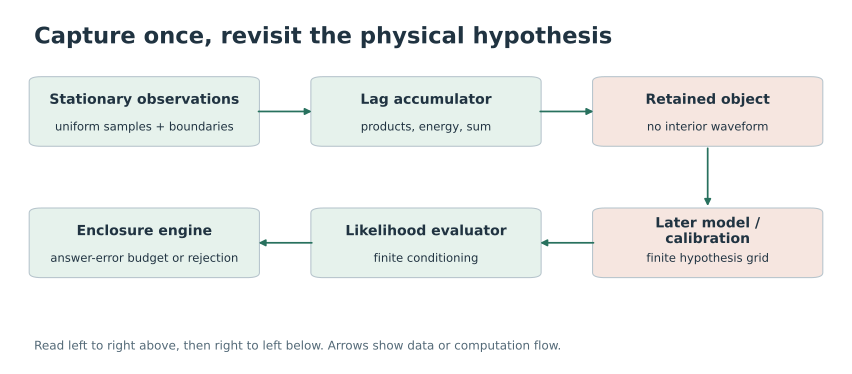
Imagine discovering that a sensor’s gain was slightly wrong after its raw recording has been discarded. A stored parameter estimate cannot generally repair itself. A record of the right quadratic information can support more: rerun a specified likelihood under revised gain, offset, or physical parameters. The scientific freedom comes from retaining evidence rather than only a conclusion.
The capture device does not choose the final model
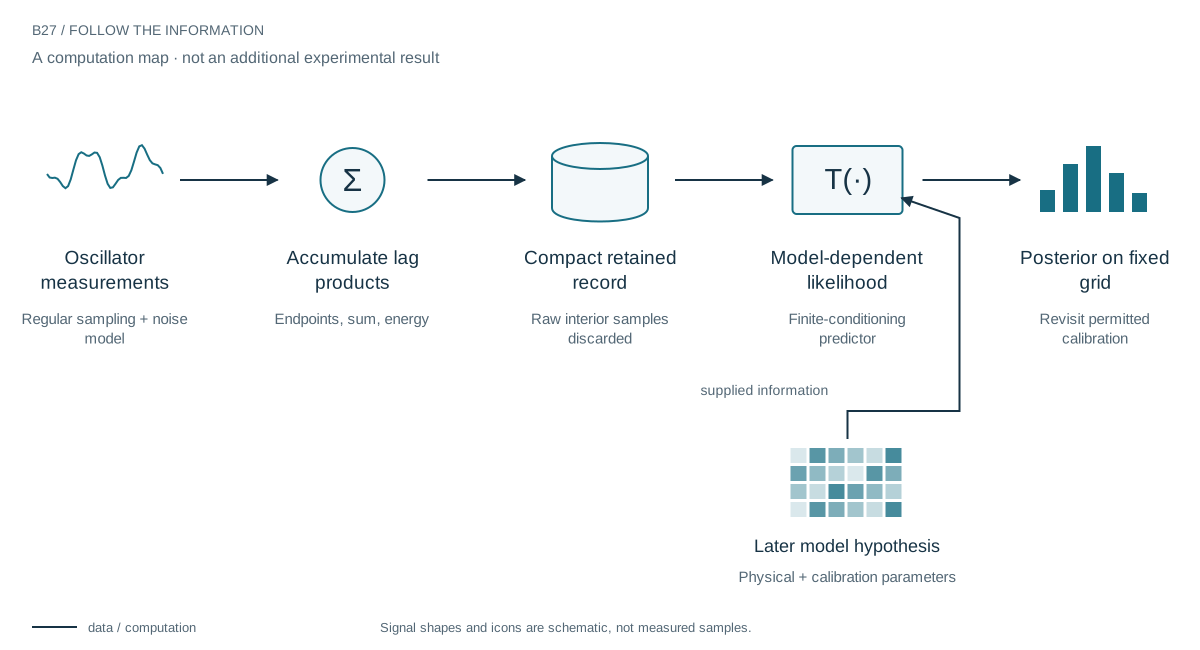
During capture, a ring buffer and balanced accumulators retain lag products, endpoints, energy, and a sum. They do not need to select the final oscillator frequency or damping. At query time, a proposed model supplies a finite-conditioning predictor; the summary evaluates its likelihood using those retained products. Gain and offset hypotheses can also be revisited under the stated observation model.
A second computation asks how much omitted long conditioning could change this record’s answer. It combines model contraction with retained record energy, then transfers the likelihood-error range to a posterior bound over the declared finite grid. This assurance path is much more expensive than ordinary evaluation.
Correlations become a computational memory
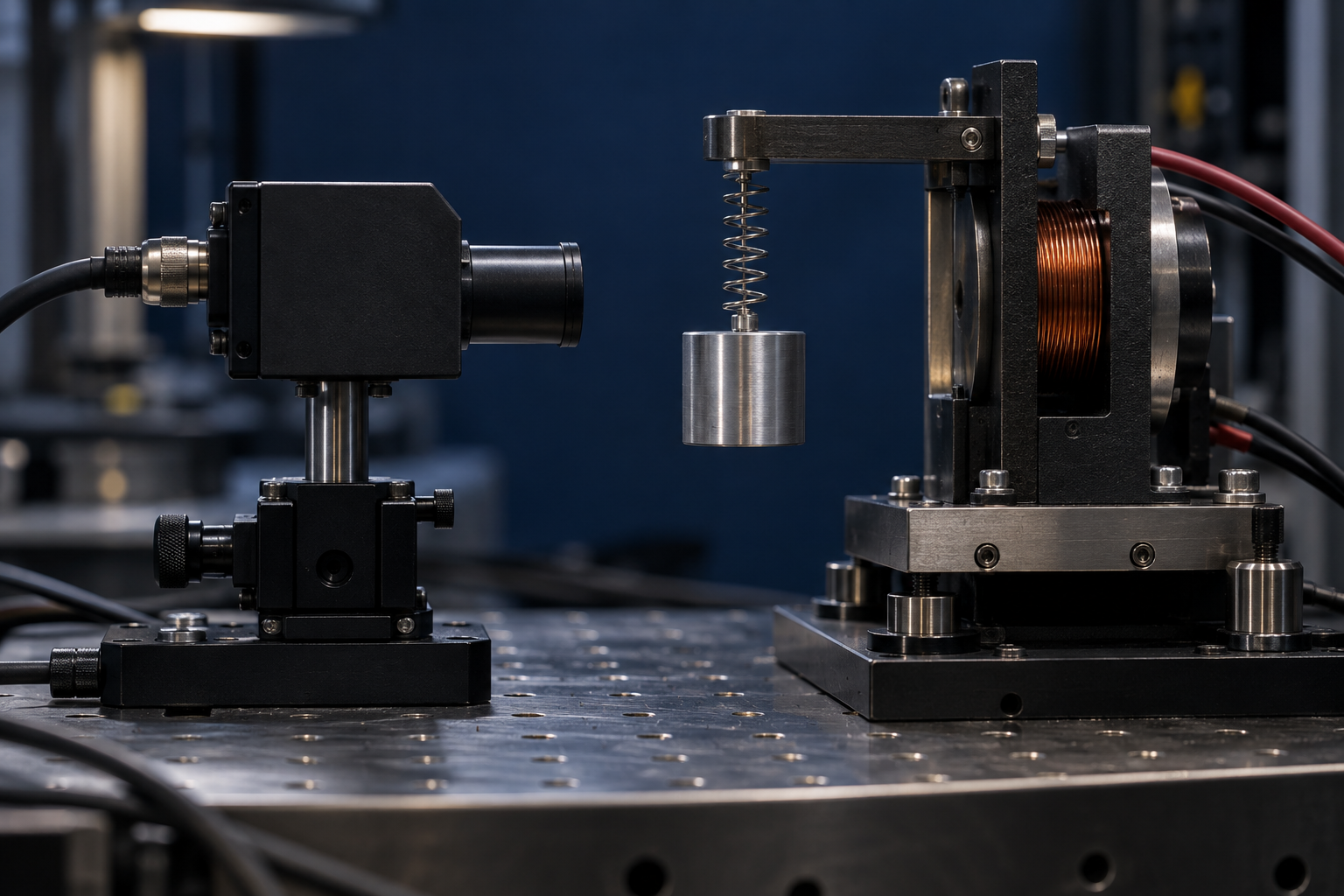
Our example is a stationary noisy oscillator. The record retains lag products, its beginning and end, a sum, and observation metadata. A later model supplies the covariance and finite-history predictor. Expanding its residual squares reduces the likelihood calculation to those retained statistics. There is no attempt to reconstruct every interior sample.
The model is part of what gets stored
Regular sampling, stationary dynamics, and known independent noise after detector gain are essential assumptions. Changing when noise enters the measurement equation changes the likelihood. Allowing both unknown forcing amplitude and unknown gain also creates an identifiability problem. A small file does not make those scientific ambiguities disappear.
The storage benefit survives a credible comparison
On the longer synthetic records, the roughly 12.6 kB summary is at least 40 times smaller than tested lossless raw storage and closely matches exact Kalman inference on a fixed 1271-hypothesis grid. A larger ordinary parameter bank also passes and has faster warm queries. For short records, raw inference is faster overall. The result is a tradeoff, not universal dominance.
An answer and an assurance calculation are different products
The ordinary query is much cheaper than independently enclosing its numerical error. A separate audit bounds posterior discrepancies using only retained data and model calculations, passing all 96 short-panel cases. That audit takes approximately 66 minutes. Saving transmission or retention could justify such work, but the assurance cost belongs beside the attractive byte count.

An instrument that permits later reinterpretation
The potential application is a scientific instrument that keeps enough evidence for a defined later reinterpretation. It is not lossless recording, and the study does not yet establish real-instrument utility. Its contribution is a compact answerable question together with a computable limit on how much discarded history can matter.
What a future instrument would need
The experiment demonstrates restricted reanalysis on synthetic data, not a calibrated optical instrument or maintenance alarm. A real application must decide which future revisions matter and compare against simpler exact statistics for that actual model. The compelling possibility remains: retain enough evidence to change an interpretation later, while being explicit about the interpretations that are no longer available.
Evidence & further reading
The links below distinguish the project record from foundational literature. This revised story does not add a new application-validation experiment.
- Revisable physical memory with bounded inference error. Spline research archive (2026). Local archive snapshot.
- Long-stream physical-memory qualification: study 06. Spline research archive (2026). Local archive snapshot.
- Finite dependence is not finite conditional memory. Spline research archive (2026). Local archive snapshot.