A colony needs more than a message format
The vision is a collection of inexpensive learners that exchange useful skills. Our bounded prototype exchanges temporal acceptance models: visit a region, avoid another, inspect two sides in order. The motion graph and planner are supplied. These models describe tasks, not motor skills learned on real robots.
The pipeline fails before the message is sent
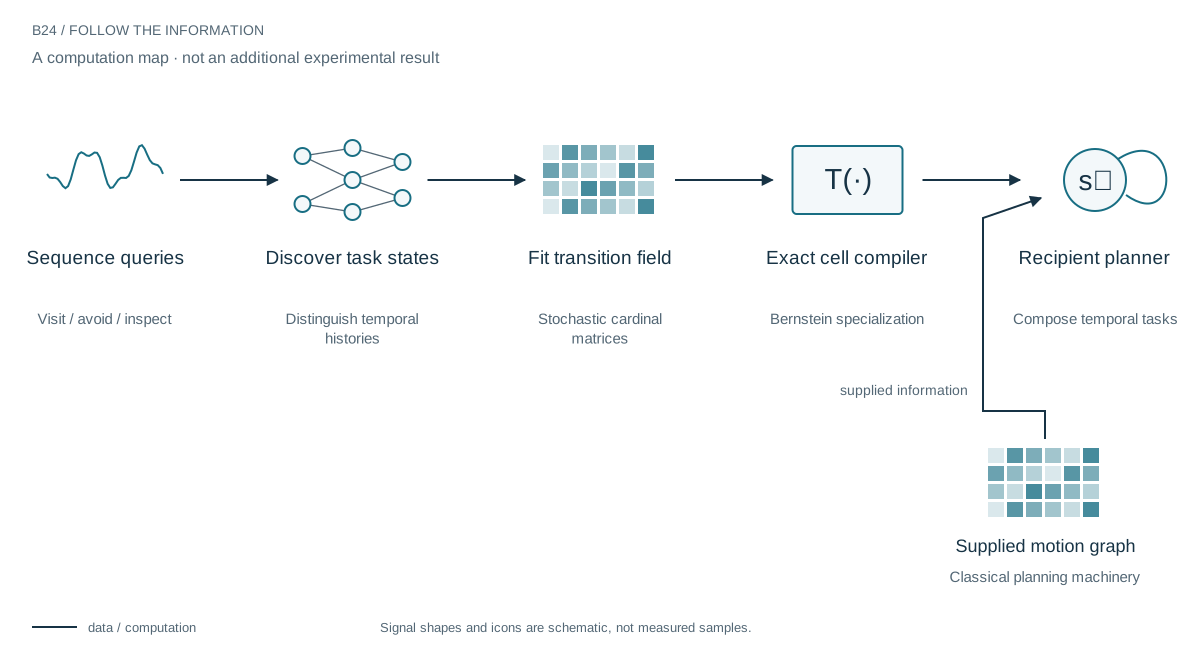
The donor learns a temporal acceptance model from sequence queries. State discovery determines which pasts are distinguishable; a coordinate-dependent transition field then predicts how those states change. Only after those stages does the exact compiler specialize evaluation and the recipient combine tasks with a planner.
When an inspection region is missing from the discovery alphabet, the learned machine can collapse to one nonaccepting state. Later fitting queries cannot recover the lost two-step distinction. Communication and replay checks can all pass while the recipient receives the wrong semantics. Many queries do not guarantee the right experiment was asked.
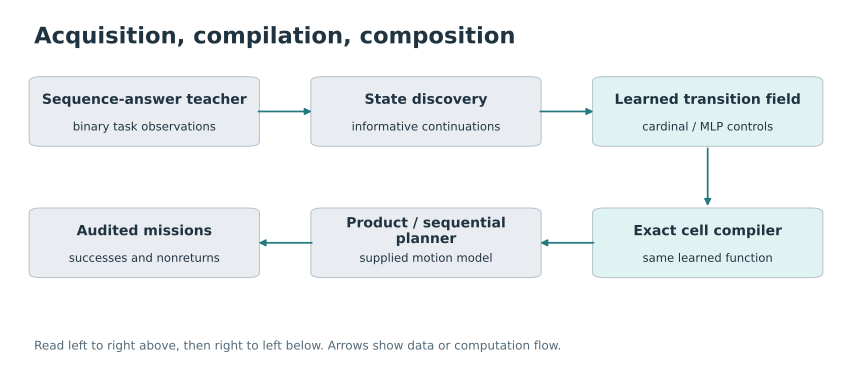
A precise role for the spline toolbox
Coordinate-dependent transition matrices use nonnegative cardinal basis weights. Stochastic coefficient matrices then produce stochastic transitions. Exact conversion to cellwise Bernstein coefficients makes evaluation cheaper while preserving the learned function. It is a legitimate compiler result—but it says nothing by itself about whether the learned states describe the task correctly.
Independent confirmation broke the capability story
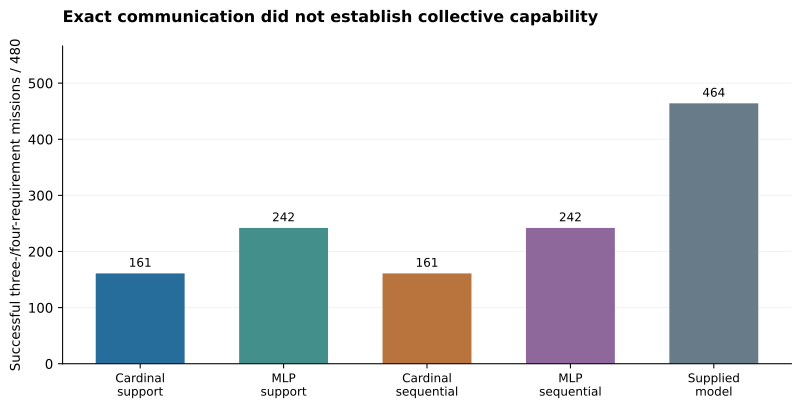
Across thirty donor pools, cardinal support models solve 161 of 480 composed missions. The matched-query MLP solves 242 and the supplied-model reference 464. Classical sequential reuse matches each learned product-planner count. The proposed beyond-classical collective capability is not demonstrated. Small payload and lower latency cannot compensate for a large capability deficit in an equal-capability claim.
The missing state could not be communicated
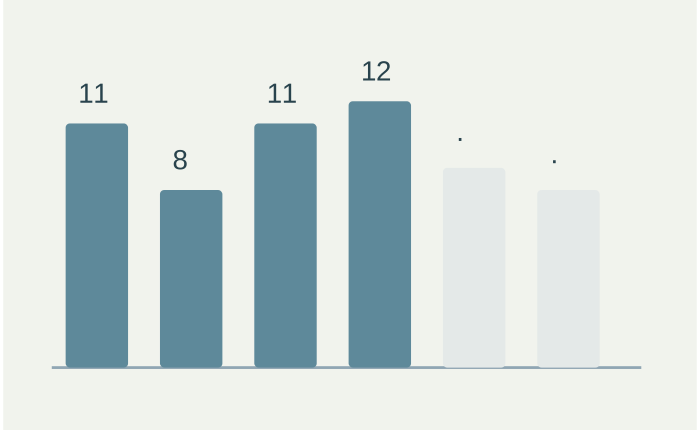
Fourteen inspection acquisitions collapse to one nonaccepting state because their discovery alphabet misses an informative region. Later queries cannot recover the two-step distinction under the collapsed continuation choice. The agents exchange exactly what they learned—an incomplete task model. More than a million queries across the campaign do not guarantee informative coverage.
Useful acquisition comes before useful exchange
The colony vision requires useful acquisition as well as portable representation. The compiler’s internal speed improvement survives, but the matched MLP and classical sequential controls prevent a collective-capability claim. That separation tells us which component is reusable and which hypothesis the confirmation study rejected.
Keep the compiler, retire the claim
On reused development scenes, exact specialization gives a 2.10–2.46-fold full-plan speed gain with checked unchanged outputs. That survives as a scoped engineering result. The capability branch remains closed. A future physical-learning colony must demonstrate acquisition and useful transfer against classical modular controls, not infer intelligence from successful serialization or immutable memory alone.
Evidence & further reading
The links below distinguish the project record from foundational literature. This revised story does not add a new application-validation experiment.
- Typed model composition and colony confirmation. Daniel Schmitter (2026). Local archive snapshot.
- Experiment-family evidence map. Spline research archive (2026). Local archive snapshot.
- Consolidated limitations and research boundaries. Daniel Schmitter (2026). Local archive snapshot.