A promise about every point
A model may preserve answers on stored examples while changing substantially between them. For a controller or physical response, those gaps matter. We ask for a stronger promise: after an update, the entire learned function on a specified interval remains unchanged. This is a continuous-domain statement, not a finite test-set score.
The protected region lives in coefficient space
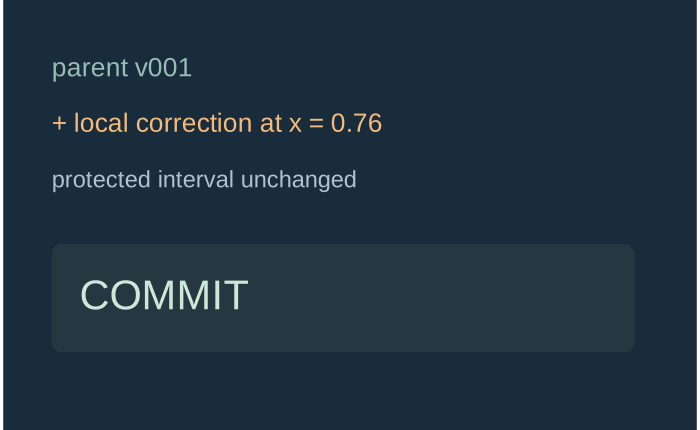
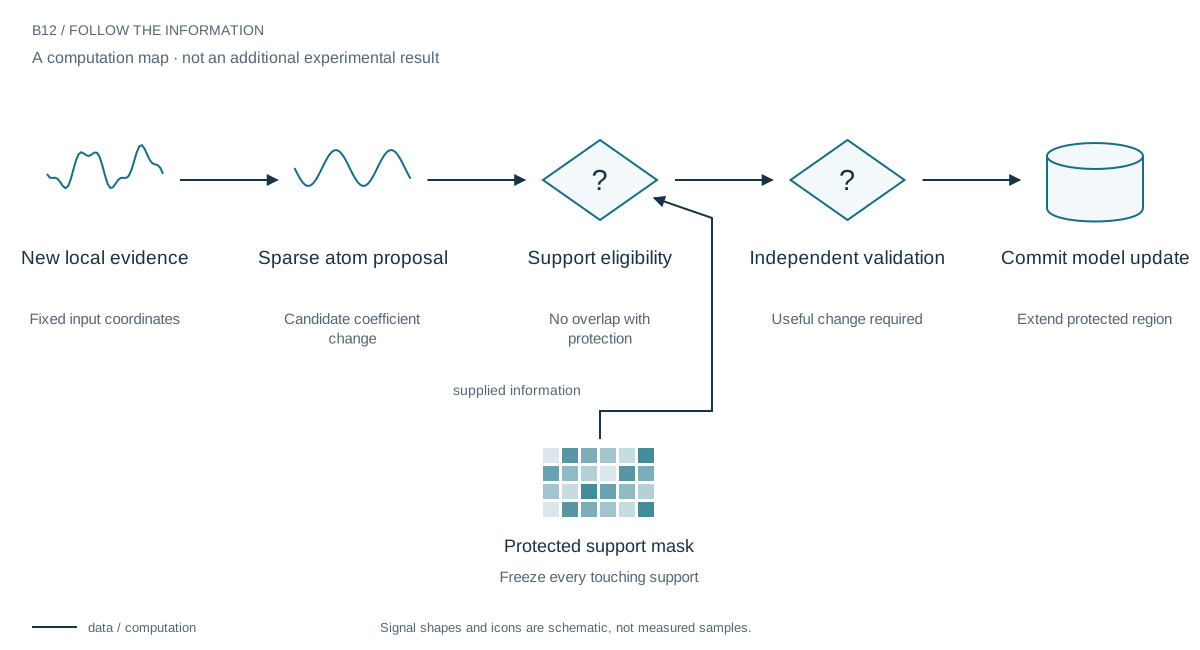
A local update is safe for a declared interval only when every changed basis function vanishes throughout that interval. The implementation therefore expands the protected set to include all touching supports. Freezing only coefficients active at a few sampled points misses functions that can change between them.
The architecture separates a sparse proposal, a support eligibility mask, and an independent validation gate. Support controls where an accepted update can act. Validation asks whether that update is useful. Neither can replace the other: a perfectly protected but inaccurate model is still inaccurate, and a useful candidate can still disturb old behavior if its support crosses the boundary.
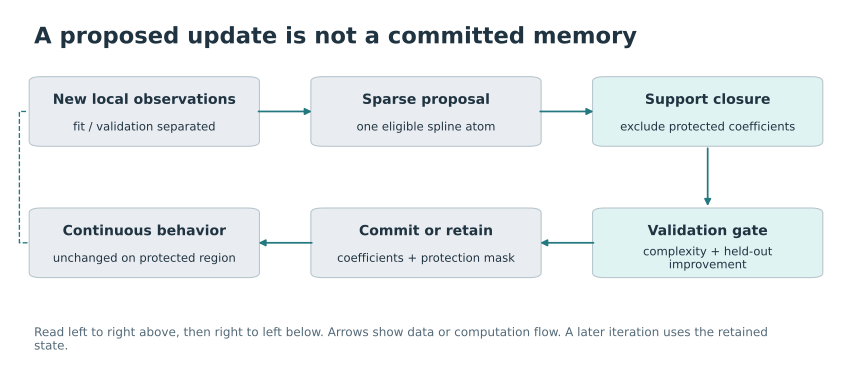
Protect the supports that touch the region
A spline basis function acts only on its support. Freeze every coefficient whose support intersects the protected interval, and change only the others. Inside the interval, every changed basis function is zero; the update contributes exactly zero there. The proof is short because the representation exposes where a parameter can have an effect.
The guarantee has real conditions
The basis, input coordinates, carrier, and routing must stay fixed. An upstream transform could move a protected input into a different region. Preserving a constitutive interval does not guarantee an unchanged physical trajectory: the state may leave it. These conditions define the mechanism; they cannot be removed by giving it a more ambitious name.
The first protected model preserved its mistakes
Continuous protection eliminated old-region drift in the synthetic stream. Yet dense local updates gave mean derivative error 0.0534, missing the 0.05 accuracy gate. No forgetting had been achieved in the declared region, but learning was not good enough. Protecting a prediction does not make it correct, and noisy early estimates can become expensive commitments.
Sparse proposals made protection useful
The successful variant proposes one atom, tests it on independent validation probes, and commits only if it passes. On twenty confirmation seeds with deliberately single-atom defects, mean derivative error is 0.000499 versus 0.0715 for the specified sequential-gradient control, with zero protected drift. A known carrier and favorable sparse geometry are supplied; this is not a general continual-learning benchmark.

An exclusion zone for model updates
The compelling capability is a local model revision with a continuous, inspectable exclusion zone. Its conditions are exact and limited: fixed coordinates, fixed basis, fixed carrier, fixed routing. This is a building block for accountable adaptation, not a guarantee that an entire changing deep network will never forget.
A building block for accountable adaptation
The opportunity is an update whose allowed effect is inspectable before deployment. It could help adaptive local response laws retain trusted regions. Capacity is finite: as protection accumulates, free directions disappear. Recursive self-improvement would also require task selection, evidence acquisition, and reliable routing. Here we have a narrower but mathematically meaningful primitive.
Evidence & further reading
The links below distinguish the project record from foundational literature. This revised story does not add a new application-validation experiment.
- Consolidated research results, including constitutive edges and continual memory. Daniel Schmitter (2026). Local archive snapshot.
- Correction: what exact Gram memory does and does not establish. Spline research archive (2026). Local archive snapshot.
- Operator-spline theory: consolidated research manuscript. Daniel Schmitter (2026). Local archive snapshot.