Learning can have an undo boundary
Many training loops treat every optimizer step as the next model. A deployed adaptive component may need a different boundary: proposed changes remain provisional until their effect is checked. The useful version-control analogy is a clear parent state, a proposed difference, evidence, and an acceptance decision—not that neural parameters suddenly become readable software source.
A transaction has two outcomes
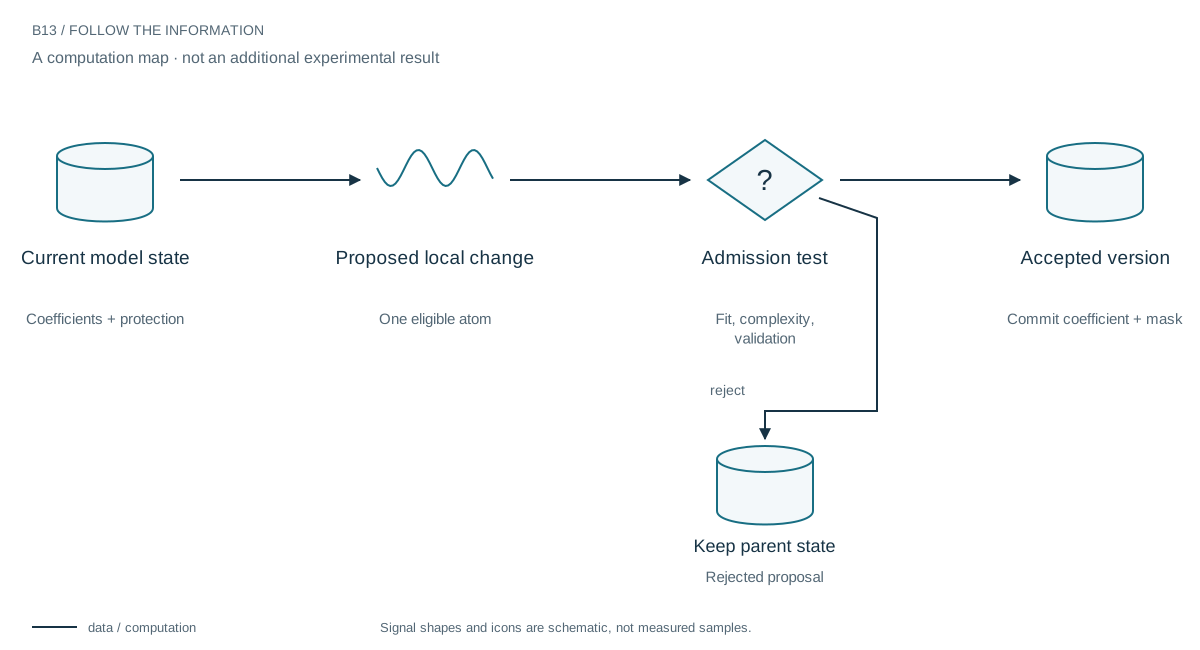
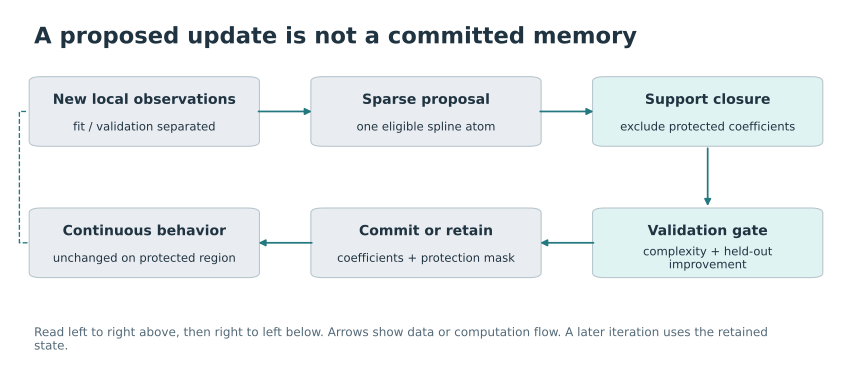
Before commitment, the candidate is only a proposal. It must be representable in free support, earn enough held-out improvement, and pass the complexity criterion. Acceptance commits the coefficient and extends protection. Rejection retains the previous coefficients and mask. The archived rule specializes this transaction to one new local atom at a time.
The test stream is intentionally structured: six aligned defects, revisits, and a null region. That makes it possible to inspect whether the method learns the intended novelty, leaves old regions alone, and declines unnecessary updates. It does not test discovering arbitrary tasks or automatically rebuilding exhausted capacity.
Separate proposal from commitment
The sparse constitutive experiment proposes a change to an eligible local coefficient. It must improve a penalized fitting criterion and reduce independent validation error by at least 5%. Only then is it committed and its interval protected. Rejection leaves the previous model and protection state intact. The proposal generator and acceptance mechanism have distinct responsibilities.
Protection is different from an old version
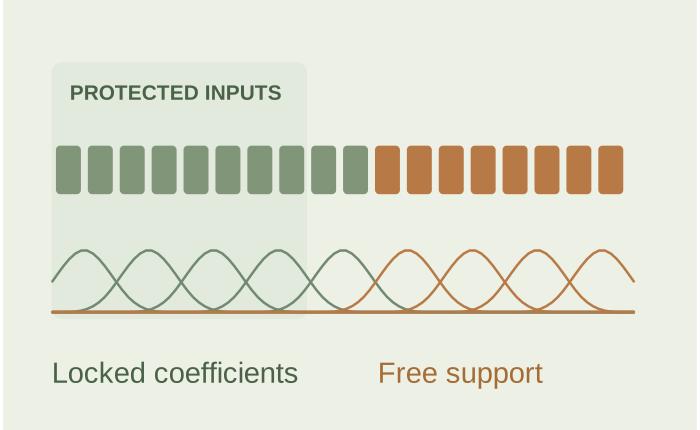
Support protection constrains changes within one current model. Immutable versions retain old functions by keeping their representations unchanged. Both can be legitimate, but versions need storage and a context-selection rule. Using the wrong old version can still fail a task even though it has forgotten nothing. Our experiment does not establish autonomous version routing.
What the bounded experiment supports
Twenty sparse confirmation streams show useful local learning with zero reported protected drift under fixed coordinates. They include revisits and null blocks as well as new defects. This supports a particular proposal-and-validation primitive. It does not demonstrate autonomous task selection, reliable behavior in unknown environments, or an ever-expanding store of general knowledge.
Why this belongs near self-improvement
A system that modifies itself must distinguish a plausible change from an improvement, and an improvement from a safe deployment. Auditable components are one possible foundation. Our work concerns a local mathematical boundary: where a change can act and whether probes support it. It does not make those probes complete or eliminate distribution shift.
A small, testable step toward accountable adaptation
The link to self-improvement is an engineering prerequisite: a system needs to distinguish a proposed change from an accepted improvement. The experiment supplies one small, testable version of that boundary. It does not yet supply an autonomous process that invents better learning algorithms or accumulates unlimited capability.
The practical object is an accountable change
The strongest interpretation is a change with a stated scope, retained evidence, and a rejecting or reversible boundary—not unlimited learning on tiny hardware. This can be useful without making the model larger or generally more intelligent. It also localizes failure: was the proposal wrong, validation uninformative, or the protected domain too restrictive?
Evidence & further reading
The links below distinguish the project record from foundational literature. This revised story does not add a new application-validation experiment.
- Consolidated research results, including constitutive edges and continual memory. Daniel Schmitter (2026). Local archive snapshot.
- Correction: what exact Gram memory does and does not establish. Spline research archive (2026). Local archive snapshot.
- Structure-preservation audit. Spline research archive (2026). Local archive snapshot.