The signal is already in the room
A laptop is usually a device for listening to people. Could its audio hardware also detect how a nearby surface moves? A transmitted tone returns to the microphone through several acoustic paths. Motion changes those paths, leaving small variations in a signal dominated by the tone and the room. Breathing is a compelling possible application because chest motion is slow and repetitive. The immediate research problem, however, is separating a useful motion signal from everything else the microphone hears.
Inside the acoustic measurement chain
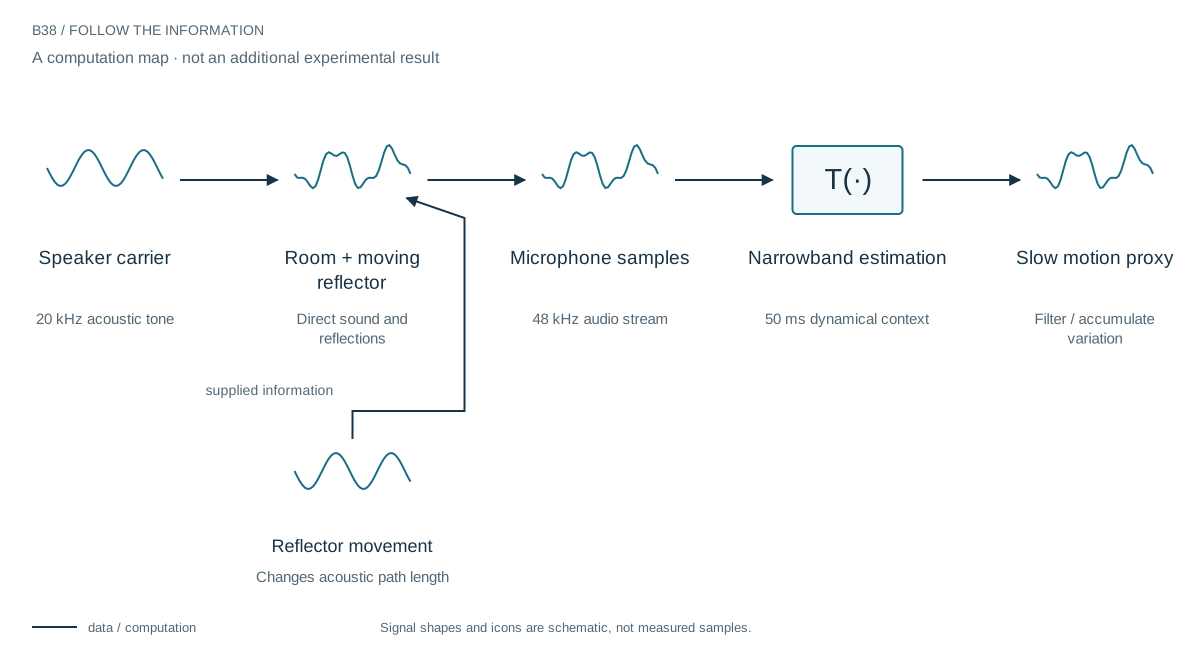
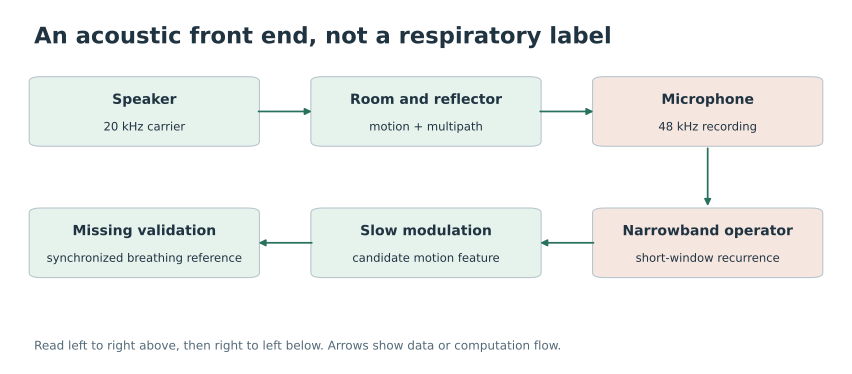
The experiment is audio-based: a speaker emits a high-frequency carrier and a microphone records a mixture of direct sound and reflections. Slow motion changes those paths. Narrowband filtering isolates the carrier region; a short-window dynamical estimator extracts a motion-sensitive quantity; subsequent filtering exposes slower variation. It is not a Wi-Fi channel measurement.
A local single-tone recurrence supplies the mathematical model, but the room supplies multipath, device filtering, amplitude changes, and unrelated movement. The estimator therefore does not directly output chest displacement. The approximately 8.1-cycle-per-minute peak in one recording is a candidate slow modulation, not a validated respiratory-rate label.
Recognize the carrier through its dynamics
A pure sampled sinusoid obeys a short recurrence. Three consecutive samples are related by a coefficient determined by frequency. That is the discrete counterpart of the oscillator differential operator, and it gives an inexpensive way to test whether a short segment behaves like a tone. The operator viewpoint replaces an arbitrary collection of signal features with a model of how the carrier evolves.
From a recurrence to an estimator
For a narrowband, approximately stationary segment, a least-squares estimate of the recurrence coefficient can be formed from dot products. Mapping that coefficient through an arccosine gives a frequency estimate under the single-tone model. The real acoustic scene is less cooperative: direct sound, multiple reflections, amplitude changes, microphone processing, and noise all affect the estimate. A changing frequency estimate is therefore a motion-sensitive feature—not automatically a calibrated chest-displacement or respiratory measurement.
What the prototype actually did
The recorded prototype used a 20 kHz carrier with 48 kHz sampling and speaker–microphone hardware. It isolated a narrow carrier band, estimated short-window dynamics, and used filtering and accumulation to expose slower variation. The implementation used 50 ms context; a smaller nominal step parameter does not establish an independent new measurement every 10 ms. The distinction matters when translating a signal-processing script into a latency claim.
A promising trace is not yet a breathing-rate measurement
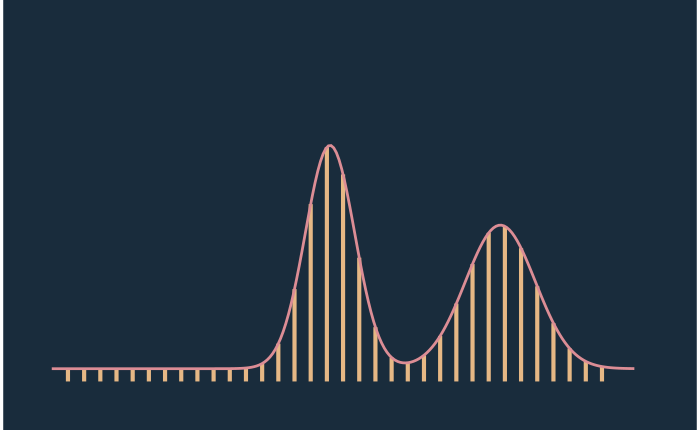
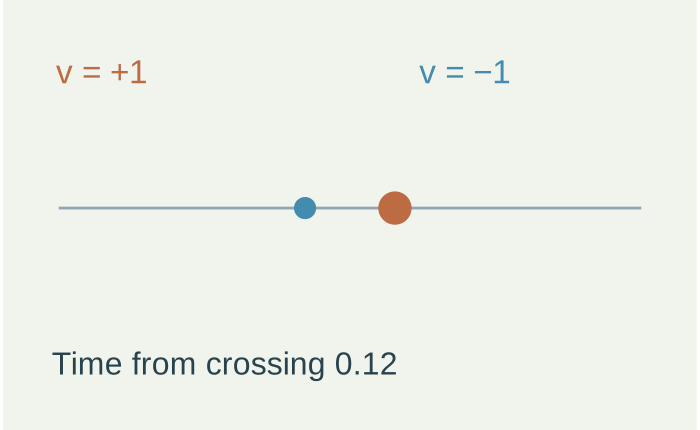
One roughly 44-second recording contains a low-frequency peak near 0.134 Hz, or about 8.1 cycles per minute. That is consistent with a possible respiratory timescale, but the recording does not include an independently synchronized respiratory reference. We therefore cannot identify the peak as validated breathing or report clinical accuracy. The animation shows the mechanism we want to test; it does not fill in the missing ground truth.
Why this belongs in a machine-learning research series
The interesting bridge is an operator-informed front end: a small dynamical calculation could supply meaningful features to a learned estimator, or reduce the learning burden by removing a known carrier. The prototype does not establish a trained respiratory model or a spline-specific performance advantage. Its value is a concrete, inexpensive experimental setting where representation, signal extraction, noise, and eventual learning have to work together.
Turn a motion cue into a validated sensing experiment
The compelling next interface would connect this operator-informed front end to synchronized physiological ground truth and ordinary demodulation controls. No person, chest-motion video, or artificial waveform should stand in for that missing validation. The revised visual concentrates on the actual speaker–reflection–microphone path and explicitly synthetic modulation, without suggesting a medical measurement was established.
The experiment that would make the story stronger
A synchronized reference belt or another validated respiratory reference would let us compare estimated motion with actual breathing. A motionless reflector, an empty room, ordinary demodulation, and deliberate non-respiratory movement would test alternative explanations. Those controls could turn a compelling physical mechanism into evidence for a useful sensor. Until then, this is an acoustic motion-sensing prototype—not a medical device.
Evidence & further reading
The links below distinguish the project record from foundational literature. This revised story does not add a new application-validation experiment.
- Contactless acoustic motion-sensing report. Local signal-sensing project (2026). Local archive snapshot.
- Contactless acoustic motion prototype: ghost_v2. Local signal-sensing project (2026). Local archive snapshot.
- Flagship stories, source corrections and visual direction. Publication audit (2026). Local archive snapshot.