The architecture in context
The system we are building
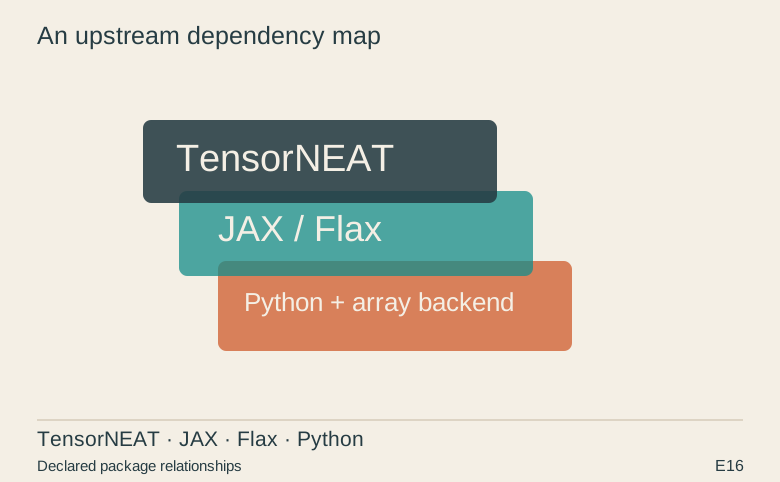
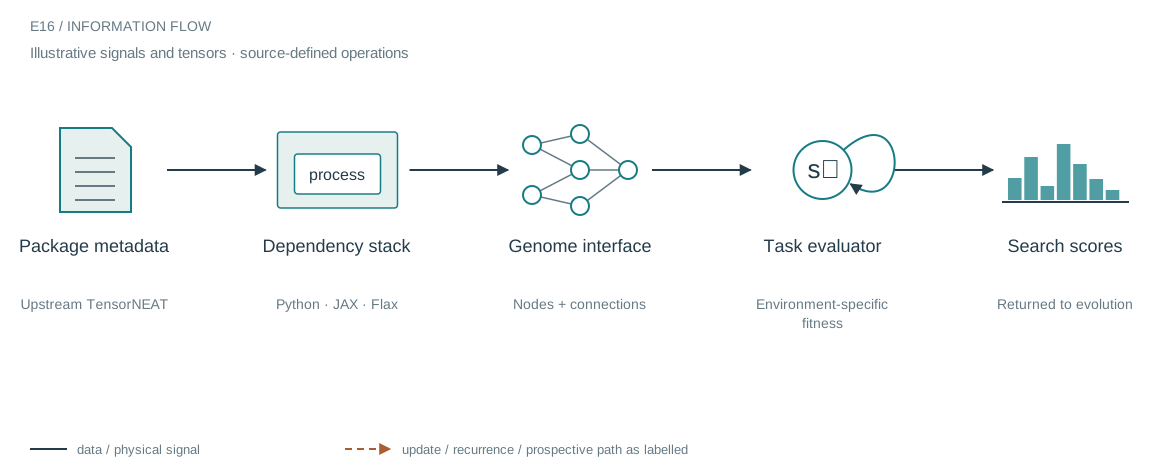
Before adapting an accelerator-oriented library, identify which layer owns each responsibility. The inspected TensorNEAT package declares JAX and Flax alongside optimization and environment dependencies. That tells an engineer where tensor transformations, parameterized models and simulation tasks enter the system. It is a dependency-level architecture, not a reverse-engineered diagram of every internal class.
Who does what in the stack
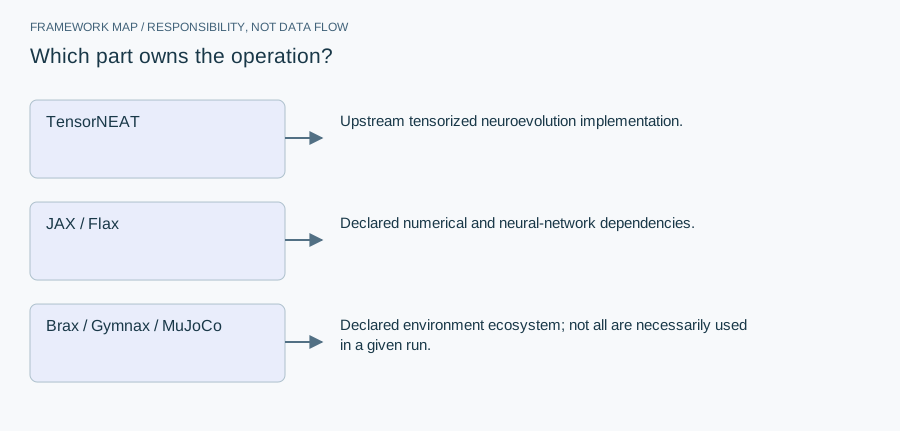
- TensorNEAT
- Upstream tensorized neuroevolution implementation.
- JAX / Flax
- Declared numerical and neural-network dependencies.
- Brax / Gymnax / MuJoCo
- Declared environment ecosystem; not all are necessarily used in a given run.
The local archive contains this upstream checkout and a separate PyTorch adaptation discussed in E17. The two must not be conflated. TensorNEAT is attributed to Lishuang Wang and the EMI Group project; retaining that boundary is essential when presenting personal engineering work.
Open up the implementation
Separate an upstream library from an experiment
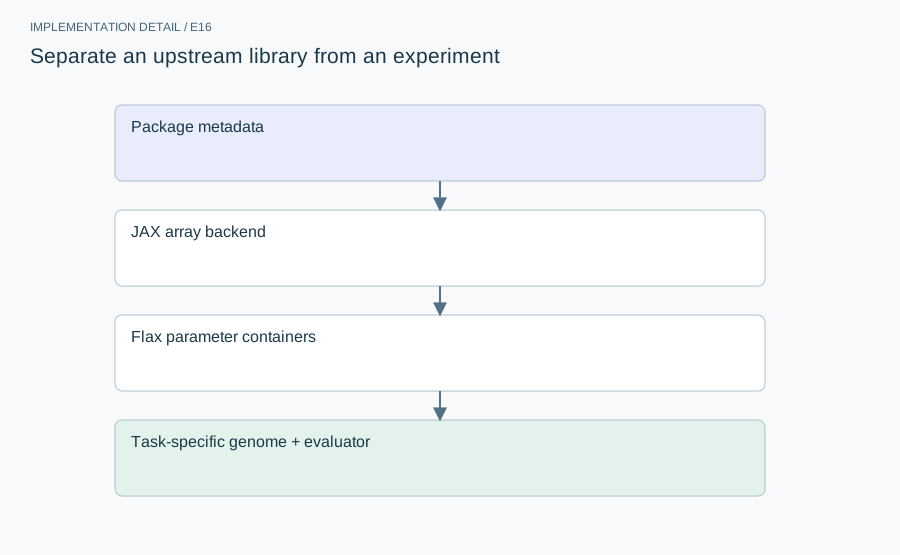
This evidence entry is an upstream package description, not a trained personal model. Credit belongs to the TensorNEAT authors. It establishes dependencies and packaging intent, not a particular network’s layer count, accuracy or runtime. E17 supplies a separate project-specific PyTorch implementation to inspect.
The mathematical contract
A lower-bound dependency permits many installed versions and therefore cannot reproduce one historical environment by itself. Record resolved versions, accelerator backend and model configuration separately. Do not infer compatibility with every newer API merely from a broad requirement.
Implementation and resource card
- Capacity / budget
- TensorNEAT metadata declares version 0.1.0, Python≥3.9, JAX≥0.4.28 and Flax≥0.8.4. These are constraints, not an exact historical lockfile.
- Execution evidence
- This revision inspects and explains the archived implementation. It does not rerun the original workload. No unrecorded convergence time, throughput or accelerator result is supplied.
- Current reproduction context
- Current workstation, supplied by the author: Apple M4, 128 GB unified RAM, 40 GPU cores and 16 CPU cores. This is context for prospective reproduction, not attribution of every archived run. Python and framework versions are not fully locked for these historical sources; declarations, when available, are identified separately.
From explanation to a reproducible check
In a fresh isolated environment, resolve and record versions before importing an example. Keep that prospective compatibility check separate from the archived result. No installation or upstream benchmark was run for this article.
Preserve input identities, configuration and failure records with the result. A successful numerical check only establishes the operation it exercises: it does not certify an entire dataset, model or deployed system. Reproduce the interface on a small deterministic input before optimizing throughput or increasing workload size.
A closer look at the implementation
The code that carries the idea
The excerpt is a dependency declaration, not executable model code. Version lower bounds describe what the package asks for, not the exact environment used in a historical run. A reproducible adaptation additionally needs the upstream commit, resolved dependency versions and the local patch set.
dependencies = [
    "brax >= 0.10.3",
    "jax >= 0.4.28",
    "gymnax >= 0.0.8",
    "jaxopt >= 0.8.3",
    "optax >= 0.2.2",
    "flax >= 0.8.4",
    "mujoco >= 3.1.4",
    "mujoco-mjx >= 3.1.4",
    "networkx >= 3.3",
    "matplotlib >= 3.9.0",
    "sympy >= 1.12.1",
Verbatim archive excerpt from pyproject.toml. Context-dependent historical code, not a standalone runnable program. Comments retain their original wording; the article distinguishes implemented behavior from stale or overbroad comments.
The boundary that matters
A package being present in an archive proves neither that it was successfully trained nor that its speed claims transfer to another backend. The local metadata indicates a BSD license; redistribution still requires checking and retaining the actual applicable license notices.