The architecture in context
What this comparison asks
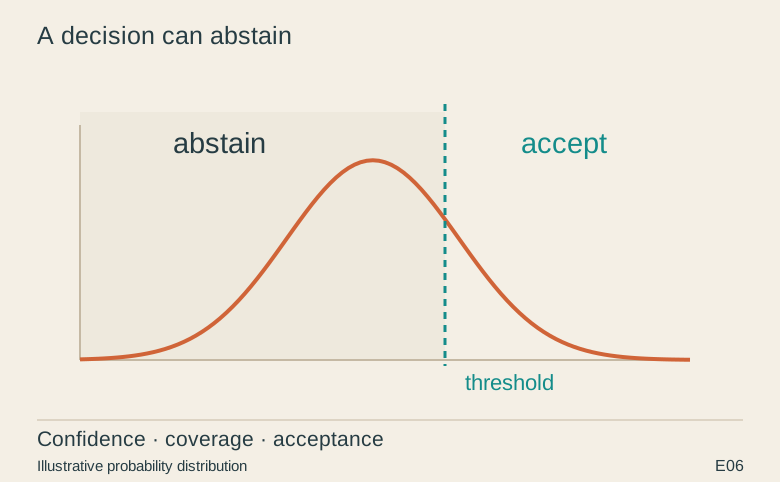
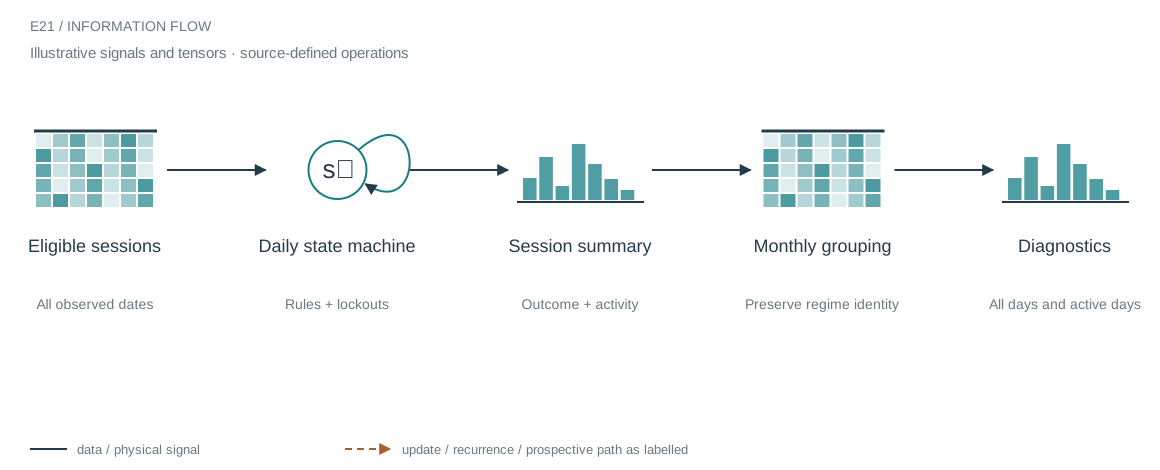
This validator collects daily outcomes and event counts before producing monthly summaries. It distinguishes total days, active days and zero-trade days. That distinction is useful beyond trading: a detector that rarely fires can look excellent on its accepted events while serving almost none of the population it was meant to handle.
Who does what in the stack
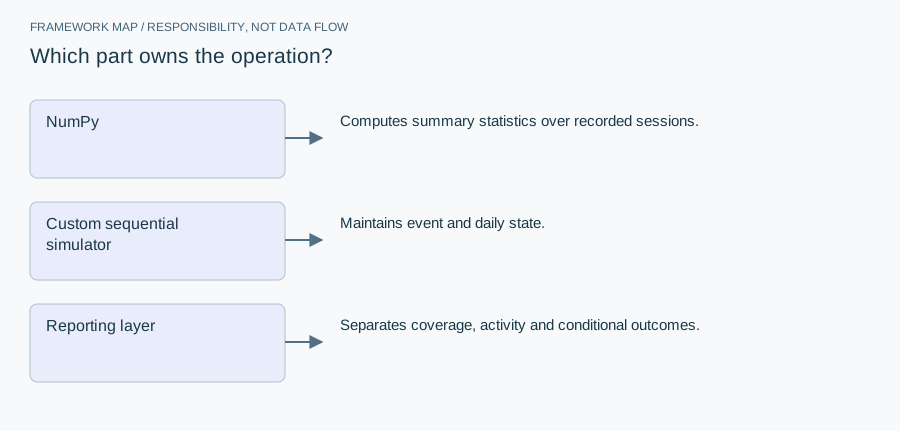
- NumPy
- Computes summary statistics over recorded sessions.
- Custom sequential simulator
- Maintains event and daily state.
- Reporting layer
- Separates coverage, activity and conditional outcomes.
The project adds daily stopping rules and context-dependent reporting around a simulator. The filename includes “parallel”, but the inspected configuration selects sequential processing. Execution order matters whenever one session or event updates a state consumed by the next.
Open up the implementation
Choose the denominator before aggregation
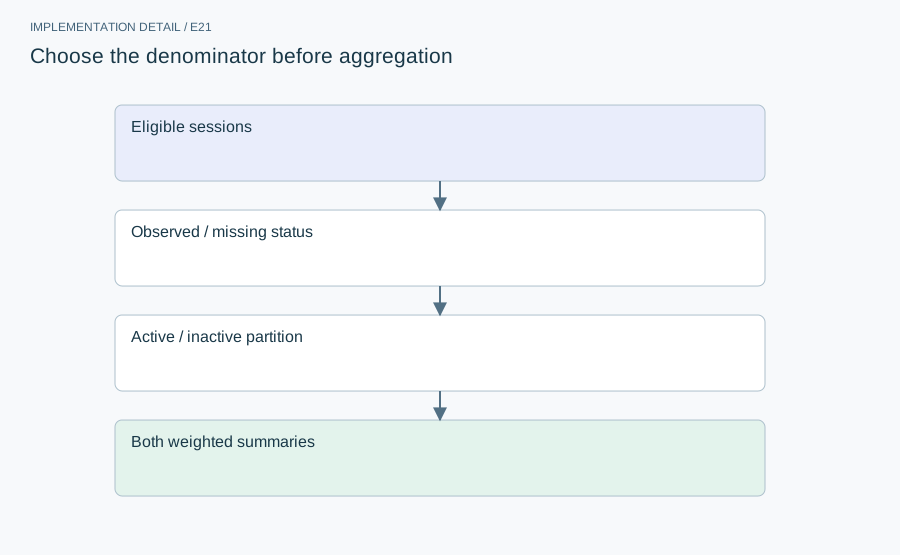
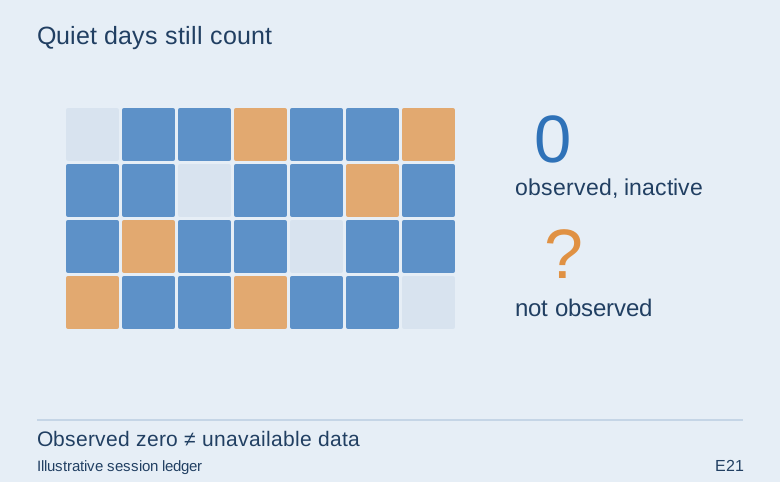
A no-action day with complete observation contributes a valid zero under an all-session outcome definition. An unobserved day is not a zero. The validator’s sequential setting must also be retained when one day’s state affects another; a filename mentioning parallelism is not proof that sessions were evaluated independently.
The mathematical contract
Session weighting treats days equally; event weighting gives more influence to busy days. Both can be useful, but switching denominators after looking at results creates an apparent improvement without a model change. Regime labels must be defined before selecting a favorable subgroup.
Implementation and resource card
- Capacity / budget
- No trainable model. Session count, activity count and coverage replace parameter/epoch fields.
- Execution evidence
- This revision inspects and explains the archived implementation. It does not rerun the original workload. No unrecorded convergence time, throughput or accelerator result is supplied.
- Current reproduction context
- Current workstation, supplied by the author: Apple M4, 128 GB unified RAM, 40 GPU cores and 16 CPU cores. This is context for prospective reproduction, not attribution of every archived run. Python and framework versions are not fully locked for these historical sources; declarations, when available, are identified separately.
From explanation to a reproducible check
Reconcile eligible=observed+missing and observed=active+inactive. Include one missing and one inactive day in a toy ledger. Confirm that the report preserves both instead of silently merging them.
Preserve input identities, configuration and failure records with the result. A successful numerical check only establishes the operation it exercises: it does not certify an entire dataset, model or deployed system. Reproduce the interface on a small deterministic input before optimizing throughput or increasing workload size.
A closer look at the implementation
The code that carries the idea
The excerpt separately computes total outcome, event count, wins, daily standard deviation and zero-action days. These are different denominators. A mean over active days and a mean over all eligible days answer different questions, so both need explicit labels rather than being swapped to improve a headline.
def calc_summary_metrics(daily_pnls, trade_counts, trade_objs, multiplier, vol_metrics=None):
    if not daily_pnls:
        keys =["TotalPnL", "Total$", "Exp", "Sharpe", "TotalTrds", "WR", "AvgDay",
                "MinDay", "NegDays", "ZeroTrd", "MCL", "GrnDays", "GrnDaysEx",
                "ATR", "ATR_RTH", "ATR_Opn", "ATR_PM",
                "Rel", "Rel_RTH", "Rel_Opn", "Rel_PM", "Corr_PM", "Corr_Opn"]
        return {k: 0 for k in keys}
    tot_pnl = sum(daily_pnls)
    n_trd = sum(trade_counts)
    wins = len([t for t in trade_objs if t.result == TradeResult.WIN])
    avg_day = np.mean(daily_pnls)
    std_day = np.std(daily_pnls)
    target_hits = sum(1 for p in daily_pnls if p >= DAILY_TARGET)
    total_days = len(daily_pnls)
    zero_trd_days = sum(1 for c in trade_counts if c == 0)
    active_days = total_days - zero_trd_days
    if vol_metrics:
        avg_atr = np.mean([v[0] for v in vol_metrics])
        avg_rth = np.mean([v[1] for v in vol_metrics])
        avg_opn = np.mean([v[2] for v in vol_metrics])
        avg_pm  = np.mean([v[3] for v in vol_metrics])
        avg_rel = np.mean([v[4] for v in vol_metrics])
Verbatim archive excerpt from validate_monthly_umbrella_v1b_v4_regime_aware_parallel_v2.py. Context-dependent historical code, not a standalone runnable program. Comments retain their original wording; the article distinguishes implemented behavior from stale or overbroad comments.
The boundary that matters
Zero is not a substitute for an unknown outcome. Missing recordings, censored horizons and a genuine no-action day need different states upstream. Regime breakdowns are descriptive unless their definitions and comparisons were fixed before inspecting outcomes.