Let perception be expensive once
Imagine adding new object categories without retraining a visual backbone each time. A pretrained encoder turns images into features; a small decision layer associates those features with labels. This division is attractive when a good encoder is already available. It also changes how we should describe the system: inexpensive adaptation does not mean perception was acquired cheaply.
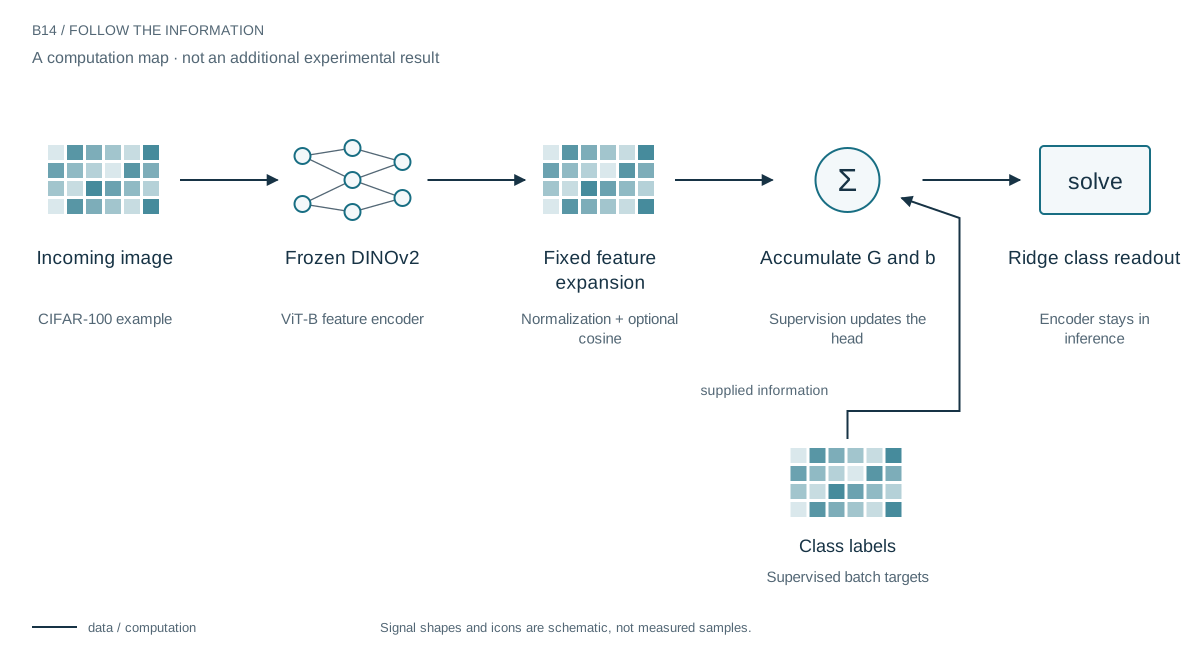
Follow an image all the way to its class
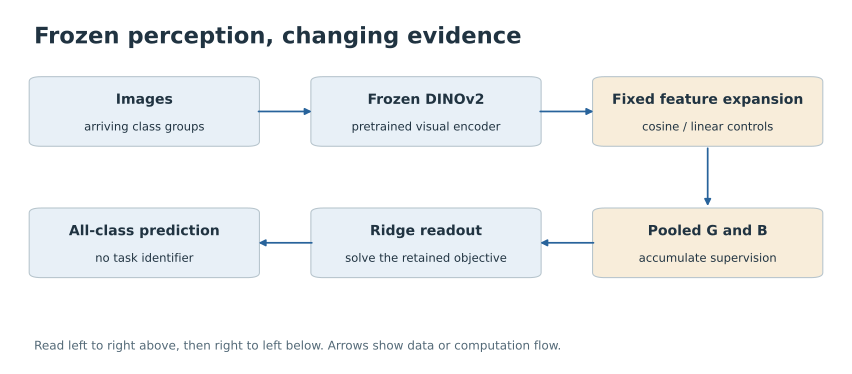
The expensive visual encoder remains in the prediction path. Its frozen feature vector is standardized, optionally expanded through random features, and multiplied by a fitted readout. Incoming supervision updates cross-products, not the backbone. The architecture is therefore a large fixed representation with a replaceable analytic head, not a small standalone vision model.
The ablations tell us where the accuracy resides. Raw-feature ridge already reaches 88.47%, compared with 89.10% for the cosine expansion. The much larger gap to sequential cross-entropy mixes representation, loss, and evidence retention. It cannot be credited solely to one special nonlinear activation.
Keep the objective, not a replay buffer
For fixed features and a squared-error readout, every labeled batch contributes two matrices. Their sums define exactly the same ridge objective as all the feature rows together. A later solve can use the combined evidence without replaying individual examples. This is a classical analytic-learning mechanism, closely related to RanPAC, rather than a new consequence of calling the features a biological substrate.
The strong number has a revealing control
On the named frozen DINOv2 ViT-B feature panel, the cosine-expanded readout reaches 89.10% final CIFAR-100 accuracy. Linear ridge on those same frozen features already reaches 88.47%. The nonlinear expansion adds about 0.63 percentage points. A ReLU-plus-raw expansion nearly ties cosine. Most of the capability is already present in the representation and ordinary pooled fitting.

Equality to a joint fit is a precise benefit
The accumulated and joint ridge implementations have identical saved final accuracies in every seed. A sequential cross-entropy head reaches a much lower 64.70%, but uses different features, a different loss, and different retention. That comparison does not isolate the optimizer. Nor does pooled-objective preservation guarantee that a conflicting new class cannot change an old prediction.
There is more behind the small head
The runner normalizes features using the complete training set before task arrival, so this is not a strictly causal online preprocessing experiment. Its default 10,001-coordinate Gram occupies about 400 MB in binary32 before other arrays. Inference still needs the encoder. These costs and information assumptions are part of the method, not footnotes to omit from an edge-learning story.
Update supervision without rebuilding perception
This can be practical when labels change more often than the visual world and a stable encoder is already available. It is less convincing as an edge-memory claim when a dense 10,000-feature Gram and the encoder are omitted from the budget. The manuscript now makes both the computation and the retained state visible.
A useful division of labor
The opportunity is modularity: retain a high-quality representation, update a precisely defined decision objective, and measure whether the resulting system serves the application. That can be valuable without inventing a new perception model or promising universal zero forgetting. The paper separates the observed accuracy, the exact estimator identity, and the remaining deployment costs.
Evidence & further reading
The links below distinguish the project record from foundational literature. This revised story does not add a new application-validation experiment.
- Consolidated research results, including constitutive edges and continual memory. Daniel Schmitter (2026). Local archive snapshot.
- Full experimental record. Daniel Schmitter (2026). Local archive snapshot.
- Negative-result appendix. Daniel Schmitter (2026). Local archive snapshot.
- Correction: what exact Gram memory does and does not establish. Spline research archive (2026). Local archive snapshot.