One memory, two coordinate systems
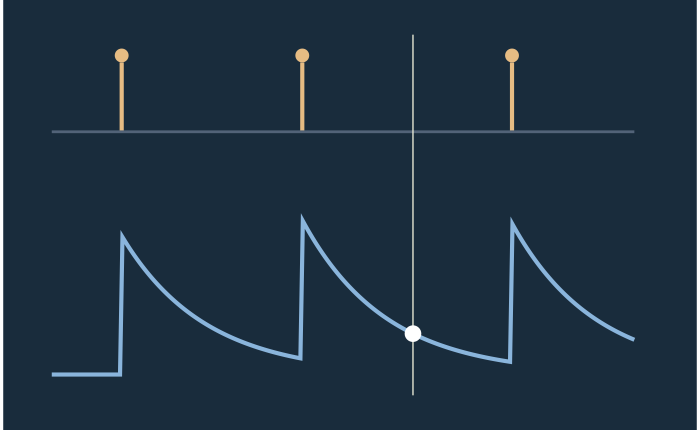
A physical consolidation model can spread a synaptic update across interacting fast and slow variables. Diagonalize its stable linear operator and the same response becomes a bank of independent exponential modes. Before rounding, the two descriptions produce the same output. Independent modes look attractive for compact implementations because their updates are simple and their time scales are explicit.
Equivalent equations, different rounding cells
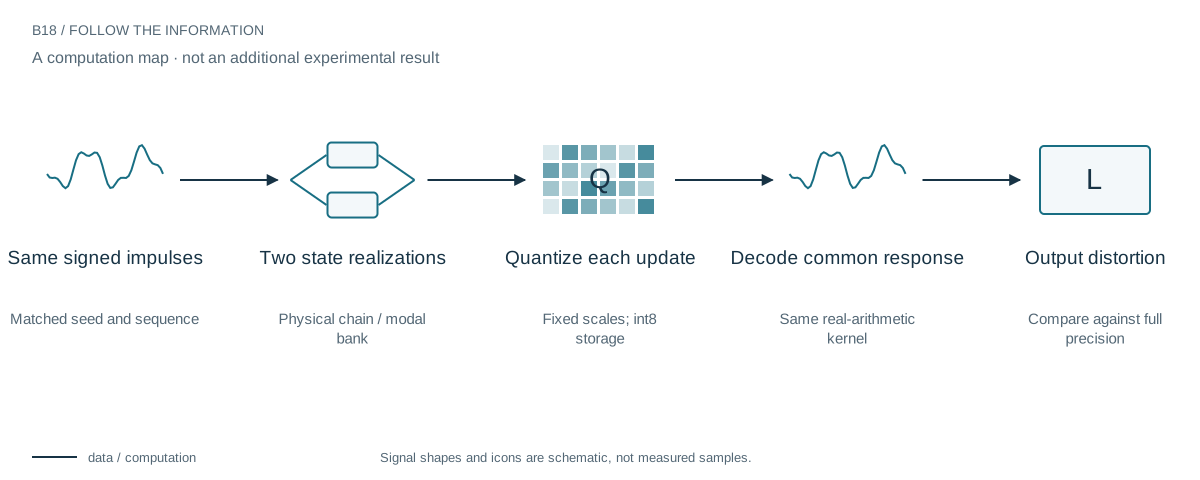
A stable physical diffusion chain can be diagonalized into independent exponential modes. Before quantization, the coordinate change preserves the entire input-output kernel. After quantization, each realization rounds inside a different coordinate system. Transforming a rounded vector is generally not the same as rounding a transformed vector.
The experiment charges equal persistent int8 state, uses the same signed impulses, and sets scales from stationary variance before sampling. Modal distortion is worse in every seed at both nominal precisions. Rare clipping rules out the most convenient explanation that one representation merely saturated more often.
A quantizer has its own geometry
On a finite-bit machine, each coordinate is rounded to a discrete code. Rotating or rescaling the state changes the lattice on which that rounding occurs. A small coordinate error can also become a larger output error when modes combine. Algebraically equivalent systems therefore need not have equal precision requirements, even with the same number of state variables.
We tested the tempting shortcut
The archived experiment fixes an eight-state consolidation kernel and compares physical diffusion coordinates with modal exponential coordinates. Both receive the same signed impulses across 2048 synapses and 2048 steps. Quantization scales come from stationary variances before the data are generated. Six independent seeds and both six- and eight-bit budgets remain in the comparison.
The independent modes were worse
Every tested modal-to-physical distortion ratio is above one. The median is 1.403 at six effective bits and 1.750 at eight. Clipping is rare, so frequent saturation is not the explanation. Before quantization, the two realizations agree near floating-point roundoff. The negative result belongs specifically to the interaction of coordinates and the fixed quantizer.
Count the implementation, not the label
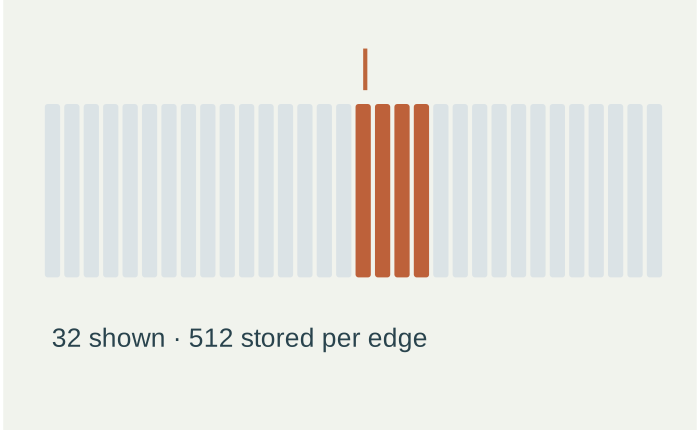
The six-bit state is stored in int8 arrays: eight coordinates consume 64 physical bits per synapse, not 48. Scales and shared operators take additional storage, while temporary calculations use float64. These details prevent a software state experiment from quietly becoming a claim about six-bit hardware energy or biological memory capacity.
Design the coordinates and arithmetic together
This is a useful lesson for tiny learned dynamical systems: the representation should be chosen together with its arithmetic. A more diagonal equation is not automatically a better low-bit implementation. The result concerns output distortion under one frozen quantization rule, not biological memory capacity or every possible quantizer.
A lesson for compact neural dynamics
A coordinate transformation can simplify an update while making its errors more damaging. State-space models, recurrent components, and compressed inference memories all face this distinction. Our result does not prove physical coordinates are universally optimal. It shows why the representation and quantizer must be evaluated together instead of treating low precision as a harmless final packaging step.
Evidence & further reading
The links below distinguish the project record from foundational literature. This revised story does not add a new application-validation experiment.
- Neuromorphic operator learning: mechanisms, evidence and limits. Spline research archive (2026). Local archive snapshot.
- Computational principles of synaptic memory consolidation. Marcus K. Benna and Stefano Fusi (2016). Primary literature.