From a notebook to a bounded service
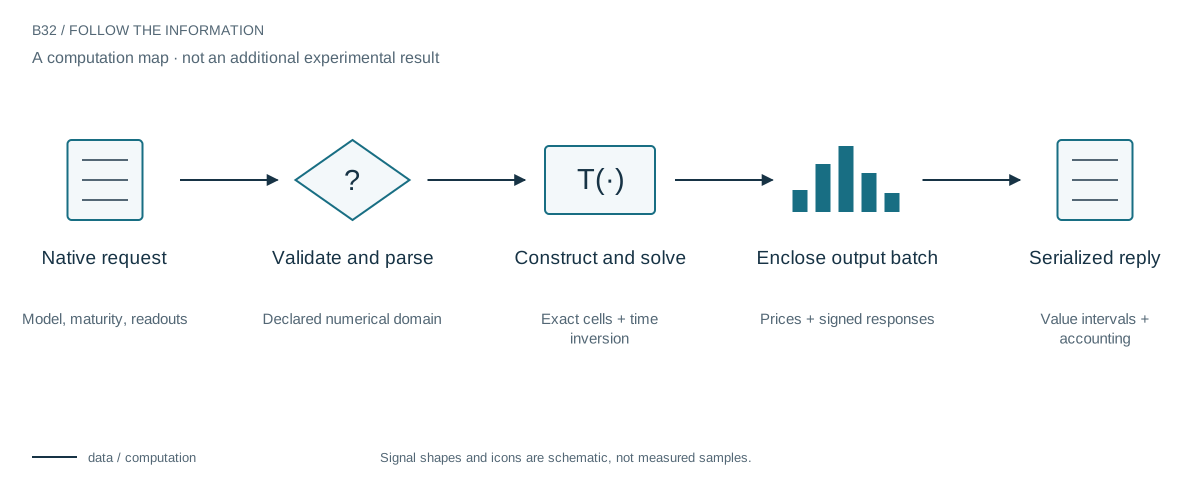
A fast kernel is not yet a usable component. A caller supplies a coefficient field and maturity, the program validates and parses the request, constructs its numerical state, computes answers, and serializes them. We measured that whole route for 23 European price intervals and two signed finite spot responses. No model training happens in the native service.
A real request includes more than the kernel
The native program parses a supplied model request, constructs its cells, evaluates resolvents and time inversion, encloses a batch of prices and signed finite responses, and serializes the result. The benchmark times that path through a pipe, not just an isolated basis evaluation. One computation thread is observed and there is no GPU, Python interpreter, or BLAS thread pool in the application.
The comparator must meet the same output-width requirement before a speed ratio is meaningful. At its largest tested budget the polynomial method qualifies six of twelve cases; the other cases remain unqualified rather than being assigned an infinite speedup. Cold startup and warm requests are reported separately.
What one thread achieved
On the shared Apple M4 Max, the exact-cell calculator has a 4.793 millisecond warm median and a 5.045 millisecond warm p95. Launch-inclusive cold p95 is 8.718 milliseconds. Peak native process memory is 2.219 MiB; the executable is 139,064 bytes. The observed calculation uses one thread and no Python, BLAS, GPU, or thread pool at runtime. The benchmark driver is a separate, larger process.
Accuracy is part of the comparison
Both the exact and polynomial paths must contain independent reference intervals and meet fixed width limits. The exact path qualifies all twelve exposed cases. The largest tested polynomial budget qualifies six. On those six—and only those six—the smallest qualifying tested polynomial budget is 52.75–206.04 times more expensive. The other cases receive no speed ratio. Wide but containing intervals are not falsely described as inaccurate point predictions.

Why this is not an edge-device benchmark
A single thread on a powerful workstation is not a measurement on a microcontroller or low-power laptop. The runs use a shared host, no fixed core affinity, and a small exposed synthetic panel. They do not establish energy use, hard deadlines, or superiority over every optimized numerical library. Those limitations constrain the headline, not the usefulness of having a genuinely small service.
Transfer the numerical contract to a target device
This is a concrete small-runtime application of the theory. It ran on a powerful workstation, so it should not yet be advertised as a measured microcontroller or low-energy deployment. The next engineering transfer would preserve its numerical request contract while measuring the actual target device.
The application opportunity
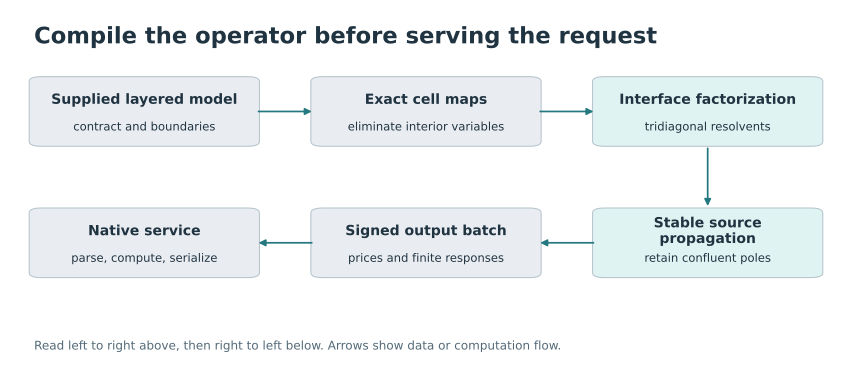
An independently usable calculation engine can sit beside a learned model: validate candidate physical parameters, supply precise targets, or answer a bounded downstream query. In this project, the next component checks model-ambiguity warnings without trusting the search that produced them. Financial utility still depends on valid observations and models; the real-data study did not cross that gate. Small computation is a capability to build with, not a promise of profitable decisions.
Evidence & further reading
The links below distinguish the project record from foundational literature. This revised story does not add a new application-validation experiment.
- Single-thread deployment succeeds on the shared workstation. Spline research archive (2026). Local archive snapshot.
- Compact operator representations for option pricing and risk. Spline research archive (2026). Local archive snapshot.
- Compact, verifiable operator-based options risk. Spline research archive (2026). Local archive snapshot.