A shared mathematical language is a starting point
Splines and quantum mechanics both use inner products and operators. But a quantum state is not an ordinary accessible coefficient array. Preparing it, transforming it through permitted operations, and reading useful observables each have costs. A smaller classical basis does not by itself imply a smaller quantum computation.
A pulse basis is not a quantum speedup
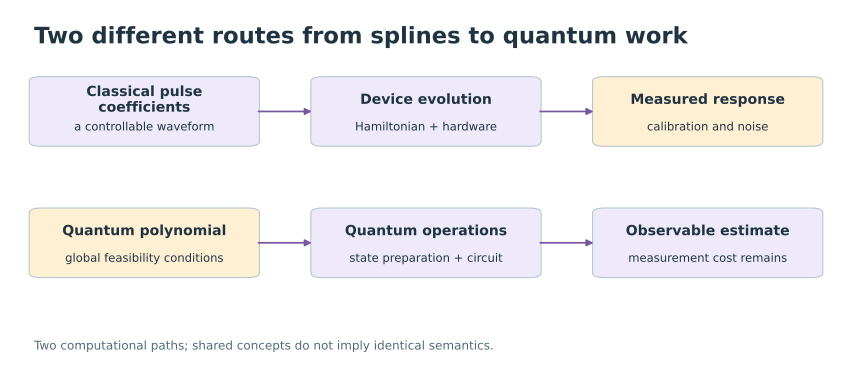
There are two different opportunities. A classical computer can optimize a control waveform whose coefficients are splines. A quantum algorithm can implement a restricted polynomial transformation through quantum signal processing. Both involve function approximation, but their allowed operations and resource costs are different. A low-degree piecewise function is not automatically a low-degree globally realizable quantum transform.
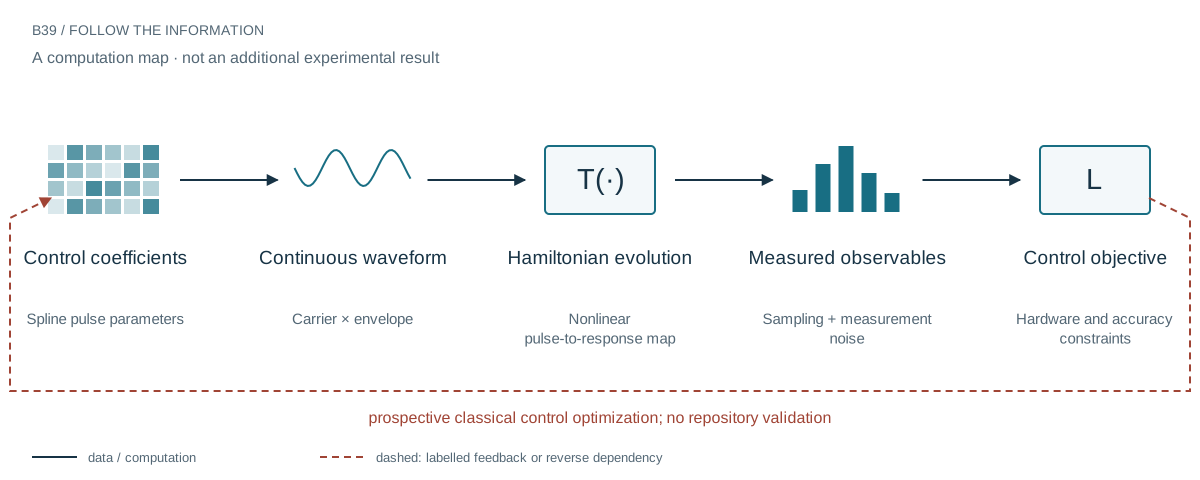
For control, the pulse-to-response map is generally nonlinear and depends on Hamiltonian evolution, hardware constraints, and measurement noise. Exact pulse inner products can help express penalties without making the complete experiment linear. Existing spline-carrier control work is therefore prior art, not evidence of a new quantum algorithm in this repository.
Even the norm has to travel with the basis
In a nonorthogonal basis, the function’s norm is a quadratic form in its Gram matrix, not the ordinary coefficient norm. Mapping to orthonormal coordinates can change conditioning and sparsity. Exact classical refinement may also be nonunitary. These are not reasons to reject the connection; they identify the construction a genuine algorithm must supply.
Control is already a substantive meeting point
Petersson and Garcia use B-splines with carrier waves for quantum pulse design. Control-adapted frame methods already connect finite response representations with characterization and prediction. A new contribution therefore cannot simply be “use splines for pulses.” It would need fewer measurements, better reliable adaptation, or lower complete computational cost under comparable physical constraints.
An attractive but untested direction
A device could retain a compact description of the responses its available controls can generate, then determine which new control questions that evidence supports. Exact cross-products and operator-matched memory might help. The pulse-to-response map is generally nonlinear, however: a spline pulse does not imply a response in the same spline space. No experiment in this archive demonstrates the proposed laboratory benefit.
A better physical interface before a quantum claim
This remains a research perspective. Its useful vision is a better calibration or control interface with fewer measurements or lower complete classical cost. The archive does not supply a quantum advantage experiment, and the series should make that absence visible while retaining the mathematical questions worth exploring.
Keep quantum execution and classical engineering distinct
Quantum signal processing imposes global polynomial and unitary feasibility conditions. A low-degree piecewise spline is not automatically a low-degree realizable transform. Conversely, a faster classical calibration method could be valuable without any quantum speedup. The literature audit keeps these opportunities separate and asks for an explicit advantage after state preparation, normalization, measurement, and the strongest existing construction are counted.
Evidence & further reading
The links below distinguish the project record from foundational literature. This revised story does not add a new application-validation experiment.
- Quantum algorithms and operator-based spline research. Spline research archive (2026). Local archive snapshot.
- An Inner-Product Calculus for Periodic Functions and Curves. Anaïs Badoual, Daniel Schmitter and Michael Unser (2016). Primary literature.
- Operator-spline theory: consolidated research manuscript. Daniel Schmitter (2026). Local archive snapshot.