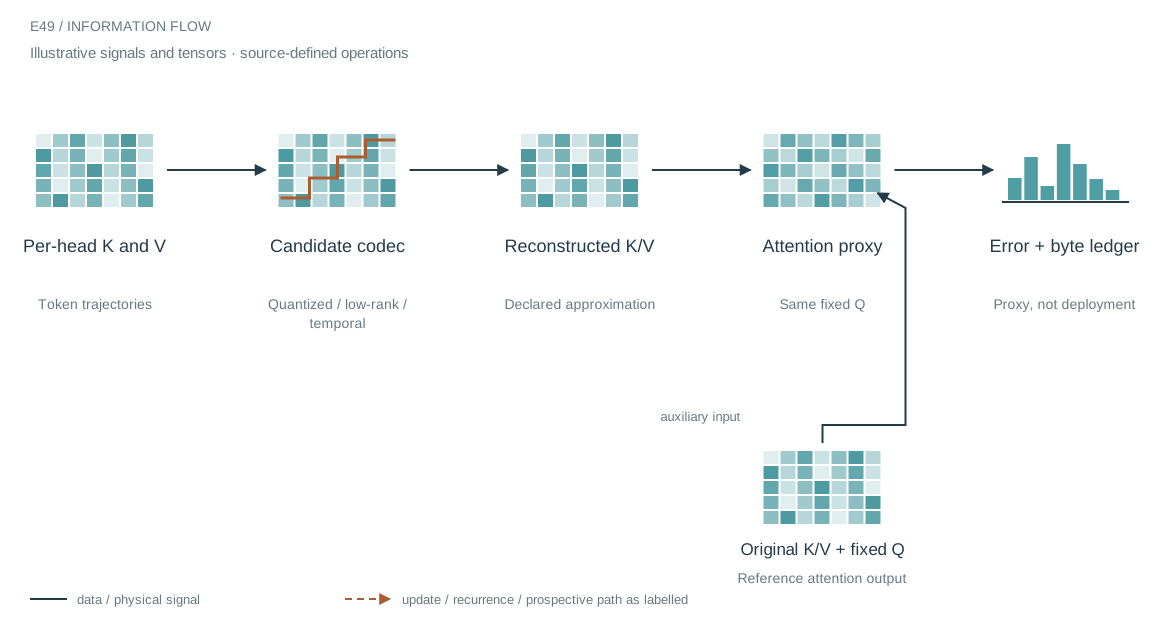
The architecture in context
The system we are building
The prototype asks whether activation trajectories can be represented more compactly than dense tensors. It compares simple quantization and low-rank baselines with temporal operator models and later piecewise or graph-based representations. Its central engineering contribution is an explicit comparator interface, not an assumption that a spline-like representation must win.
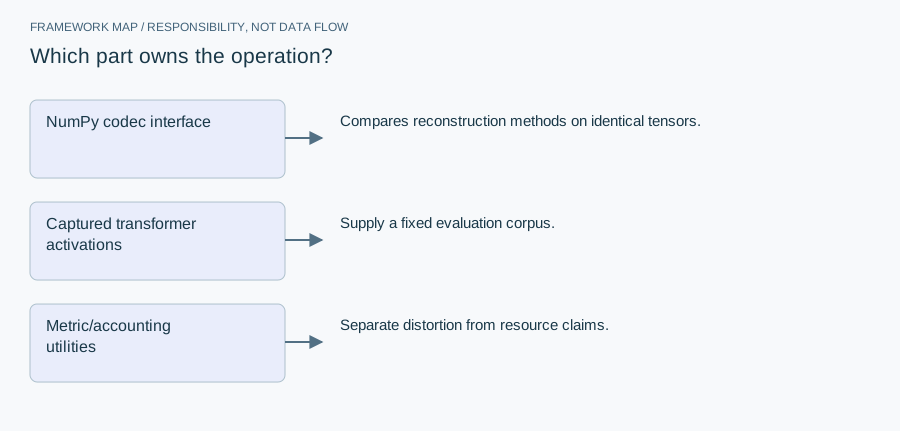
Who does what in the stack
- NumPy codec interface
- Compares reconstruction methods on identical tensors.
- Captured transformer activations
- Supply a fixed evaluation corpus.
- Metric/accounting utilities
- Separate distortion from resource claims.
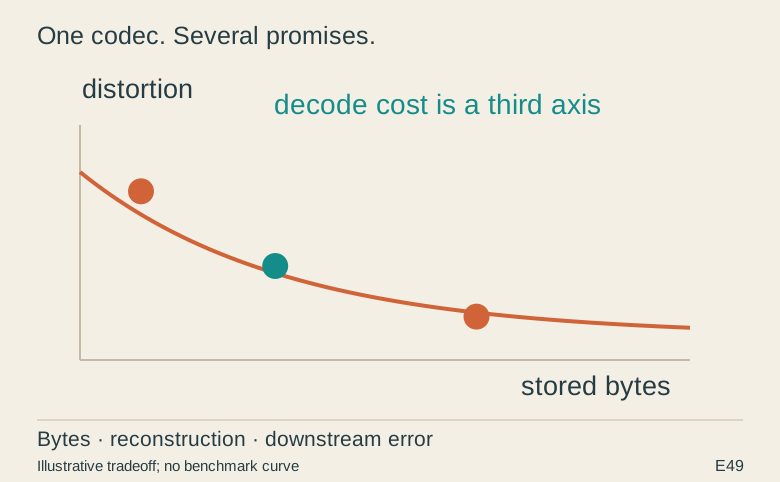
The benchmark evaluates tensor reconstruction, an attention-output proxy and estimated representation size. Those measures are deliberately separate. A representation can fit K and V well in Frobenius norm yet damage an important attention direction, or require more metadata than its coefficients suggest.
Open up the implementation
Compare codecs at the same reconstruction interface
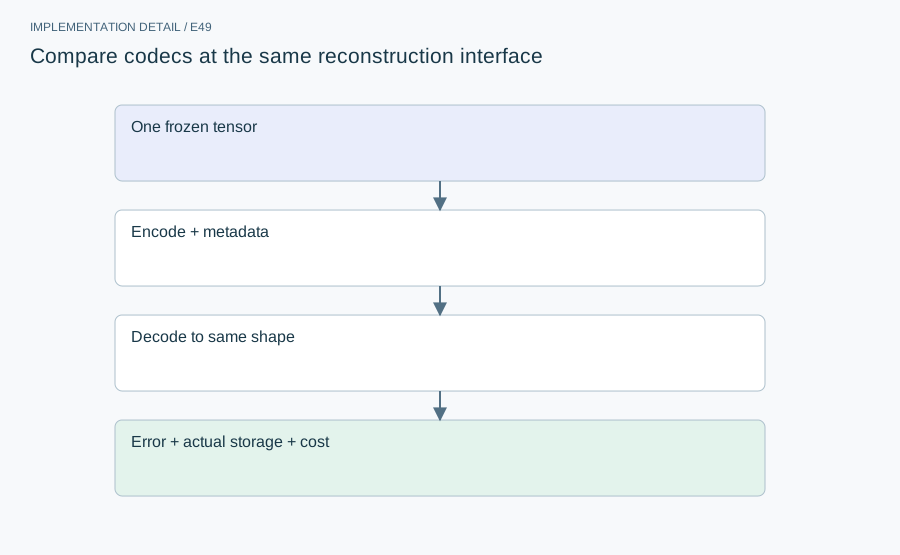
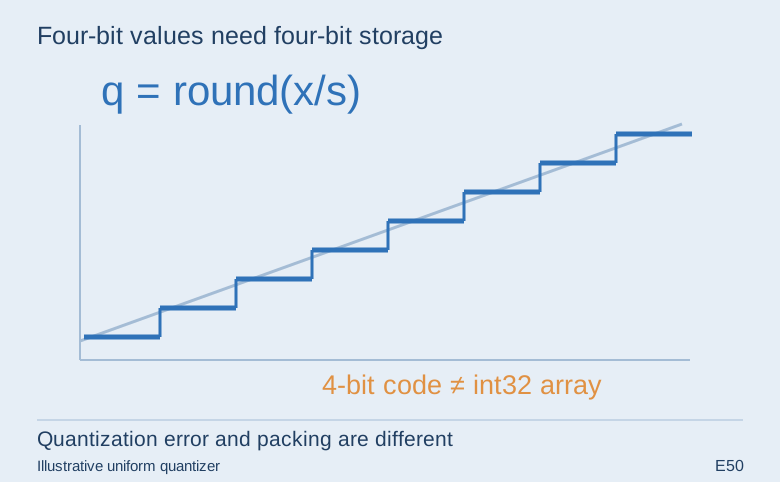
Every codec must return a tensor with the same axes and dtype contract before downstream error is meaningful. A factorization’s coefficient count is not necessarily its serialized byte count. Metadata, scales, indices, padding and retained bases can dominate small tensors.
The mathematical contract
A method with low tensor error may disturb important attention directions; a good proxy score may still fail in generation. Keep codec fitting cost, decoding cost and downstream quality separate. This archive explores representations, not an integrated accelerated autoregressive cache.
Implementation and resource card
- Capacity / budget
- Methods include quantization, low-rank and dynamical/polynomial approximations. Their rank/order/bit budget is not a shared neural parameter count.
- Execution evidence
- This revision inspects and explains the archived implementation. It does not rerun the original workload. No unrecorded convergence time, throughput or accelerator result is supplied.
- Current reproduction context
- Current workstation, supplied by the author: Apple M4, 128 GB unified RAM, 40 GPU cores and 16 CPU cores. This is context for prospective reproduction, not attribution of every archived run. Python and framework versions are not fully locked for these historical sources; declarations, when available, are identified separately.
From explanation to a reproducible check
Round-trip a tensor with known rank and a tensor with isolated outliers. Account for a real byte buffer where available; otherwise label storage an estimate. Do not compare estimated bits to another method’s actual resident allocation as if they were equivalent.
Preserve input identities, configuration and failure records with the result. A successful numerical check only establishes the operation it exercises: it does not certify an entire dataset, model or deployed system. Reproduce the interface on a small deterministic input before optimizing throughput or increasing workload size.
A closer look at the implementation
The code that carries the idea
The companion excerpt is the simple quantization baseline. It reconstructs a float tensor and estimates a packed payload from a nominal bit depth. That is useful as a distortion control, but it is not itself a serialized compressed cache.
def uniform_quantize(x: np.ndarray, bits: int = 8):
    qmax = (1 << (bits - 1)) - 1
    max_abs = np.max(np.abs(x))
    scale = 1.0 if max_abs == 0 else max_abs / qmax
    zero_point = 0
    q = np.clip(np.round(x / scale), -qmax - 1, qmax).astype(np.int32)
    x_hat = (q.astype(np.float32) * scale).astype(np.float32)
    bytes_used = q.size * bits / 8 + 8  # scale + zero-point metadata
    return x_hat, {"bits": bits, "scale": float(scale), "zero_point": int(zero_point), "bytes": float(bytes_used)}
Verbatim archive excerpt from quant.py (companion source E50). Context-dependent historical code, not a standalone runnable program. Comments retain their original wording; the article distinguishes implemented behavior from stale or overbroad comments.
The boundary that matters
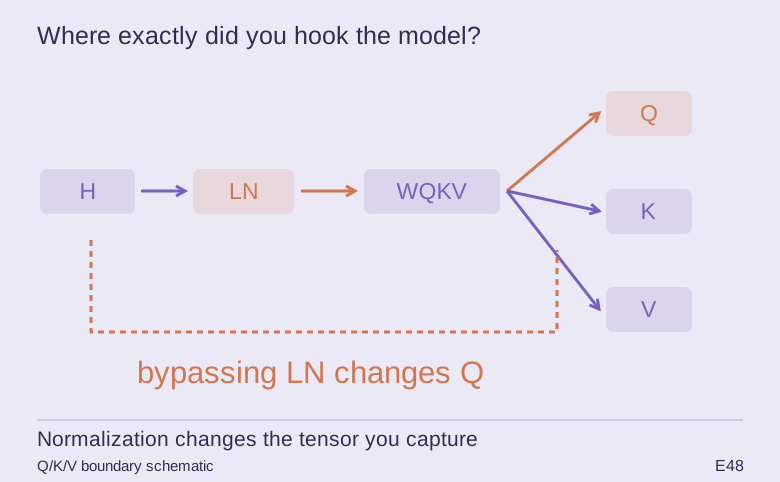
The README describes a broader sequence of experiments than the selected CSV alone contains. No end-to-end generation quality, measured cache latency or deployed memory reduction follows from a proxy comparison. E48 and E51 identify additional boundaries in query capture and masking.