The gate before a useful risk calculation
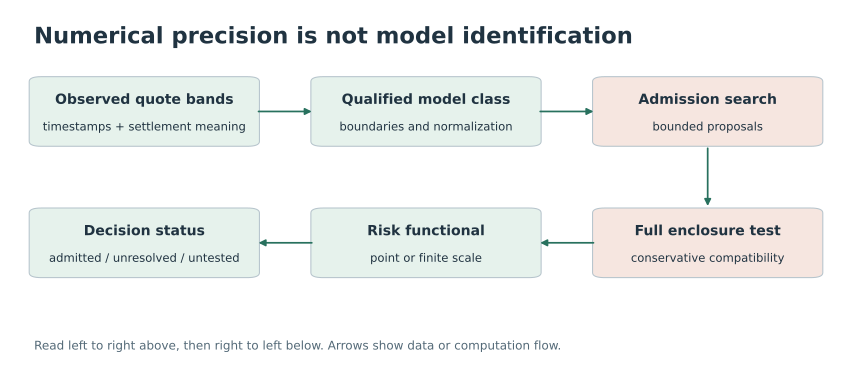
A model can return accurate prices for its own equation and still fail to explain actual quoted instruments. Before using our compact engine for model-risk warnings, we asked whether a proposed coefficient field satisfied a declared observation procedure. That gate includes contract semantics, not only a residual against a convenient midpoint.
The contract determines the observation operator
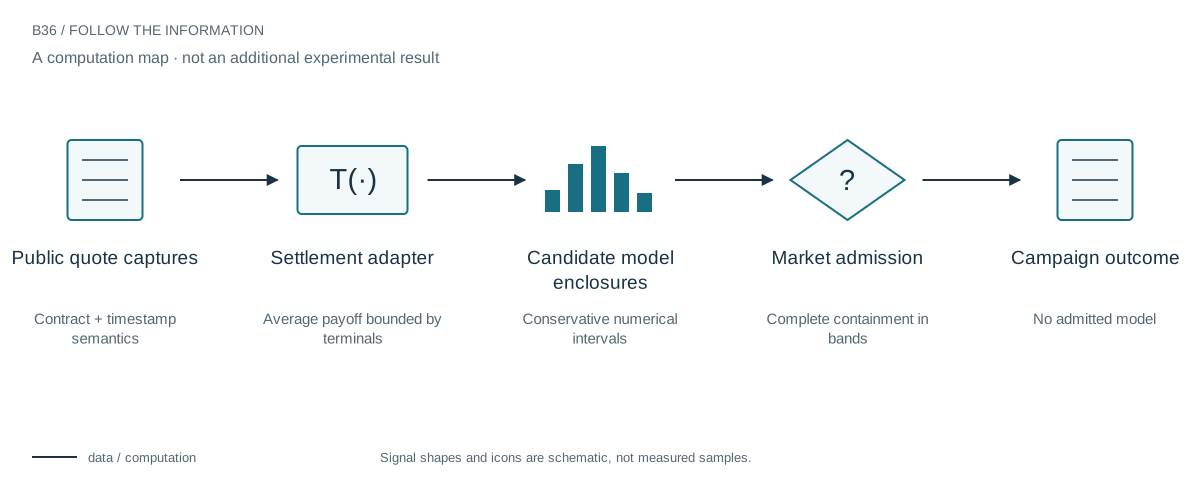
An option settled on an average over a time window is not identical to a terminal-payoff option. The market experiment therefore qualifies normalization, settlement, timestamps, and quote uncertainty before model comparison. Its adapter supplies a conservative interval under stated assumptions. Admission requires complete containment, not merely a convenient midpoint fit.
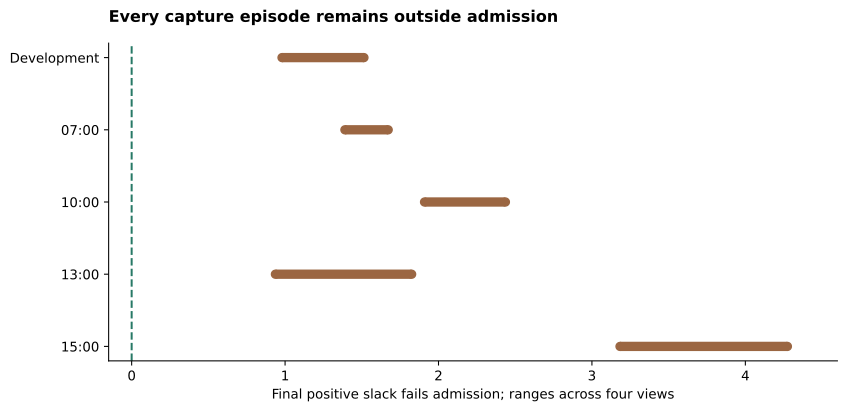
All 92 retained proposals fail the bounded campaign’s procedure. This leaves the planned risk comparisons untested. Some optimizers report success, but successful numerical termination is not successful market admission. Conversely, failure of the conservative procedure does not prove that every model in the class is incompatible.
A settlement detail changes the mathematical object
The selected public options settle against a thirty-minute average. A terminal European payoff is not the same contract. Under the stated martingale and normalization assumptions, Jensen bounds sandwich the averaged payoff between two terminal calculations. This gives a conservative adapter, not an exact average-option price. Admission requires its entire numerical enclosure inside each quote band.
All proposals remain in the account
Five capture episodes produced twenty overlapping views of 102 instruments. Twelve homogeneous proposals, sixty clock-study midpoint proposals, and twenty direct-feasibility proposals failed admission. The twenty views share observations; they are not twenty independent days. Fifteen direct searches reported optimizer success, but none satisfied the application’s gate. All 120 planned risk directions remained untested.
What failure does and does not establish
The result says this bounded procedure did not reach a usable market-risk test. It does not prove that the entire local-volatility class is infeasible, because the adapter is conservative and the search is incomplete. A necessary-band audit also found no elementary within-expiry contradiction. There is no justified shortcut from these facts to blaming one particular market feature or claiming a hidden trading edge.
Connect the calculator to the observation
This is the missing application boundary behind a very fast calculator. A useful service needs both trustworthy arithmetic and a justified link to what the observations actually measure. The closed campaign establishes the first component’s capability without manufacturing the second.
The numerical component survives the negative result
Saved-field terminal comparisons still show a compact and accurate operator calculation. That capability can be studied on its own. But making it faster cannot repair an observation/model mismatch. The study is closed without a rescue search: its useful contribution is a reproducible boundary between a successful computational component and an application that has not been demonstrated.
Evidence & further reading
The links below distinguish the project record from foundational literature. This revised story does not add a new application-validation experiment.
- Public-data options bridge: final findings. Spline research archive (2026). Local archive snapshot.
- Compact computation and model ambiguity in option risk. Spline research archive (2026). Local archive snapshot.
- Single-thread deployment succeeds on the shared workstation. Spline research archive (2026). Local archive snapshot.